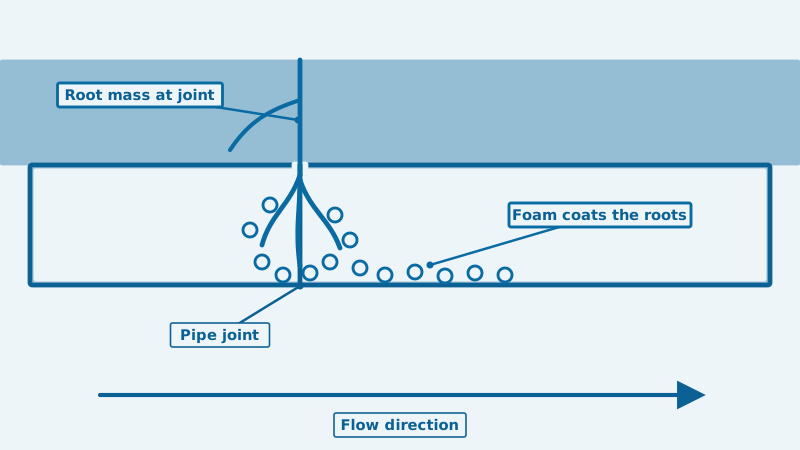
Nothing dissolves tree roots in a sewer line quickly. Copper sulfate crystals and foaming root killers poison the roots they touch, so those roots die and rot away over weeks, and the line may stay open for months. A root mass that is already blocking the pipe is cut out mechanically with a blade or a water jet. If you want to treat roots after they are cut, our guide to foaming root killer covers that product in detail.
What dissolves tree roots in a sewer line?
Chemical root killers do not dissolve roots like acid dissolves metal. Copper sulfate and dichlobenil foam kill the root tissue inside the pipe, and the dead roots then break down and wash out over weeks. They slow regrowth. They do not clear a line that is already blocked.
The products people mean are:
- Copper sulfate crystals. A blue salt that is flushed into the line and poisons roots on contact.
- Foaming root killers. A foam that coats the pipe wall and sticks to roots. A common one uses dichlobenil as its active ingredient, according to its EPA label.
- Mechanical cutting. A rotating blade on a cable, or a high-pressure water jet, that shreds roots physically. This is what opens a blocked line.
Both chemicals are registered pesticides. That means the label is the rule, including the amount, the number of treatments and the places where it may not be used.
What dissolves tree roots in sewer lines fast?
Only mechanical cutting is fast. A blade or jetter clears a blocked line in an hour or two. Chemicals take days to weeks to kill roots and longer for the dead roots to clear. If your drains are backing up now, cut first, then treat or repair.
The honest timeline:
| Method | Time to open a blocked line | Time for roots to die | How long relief lasts |
|---|---|---|---|
| Cable with a root blade | Hours | Not applicable | Weeks to a few years |
| Hydro jetting | Hours | Not applicable | Weeks to a few years |
| Copper sulfate | Does not open a block | Days to weeks | Months |
| Foaming root killer | Does not open a block | Days to weeks | Months |
| Lining or repairing the joint | Clears the entry point | Not applicable | Years, since roots cannot re-enter |
Relief lasts as long as it takes the tree to send new roots into the pipe. A thirsty tree near a leaking joint can do it within a year. See hydro jet sewer cleaning for the cleaning side.
Is copper sulfate safe and legal for sewer lines?
Los Angeles County is not among the nine counties named on one EPA label (Reg. No. 56576-1) where it cannot be sold or used for root control in sewers, but the label sets limits everywhere. We did not find a Los Angeles City or County rule on root killers either way, so check the current label and ask LA Sanitation before you use one.
Copper is toxic to aquatic life and to the microbes that treat sewage, so use it only as the label directs.
What labels such as EPA Reg. No. 56576-1 say, in brief:
- Do not exceed 2 pounds of crystals per treatment of a sewer line, and 8 pounds in a year, on the labels we read.
- Some labels also say to notify the local sewage treatment authority before discharging it to a sewer system.
- It is not for use in storm drains or municipal storm sewer systems, on the labels we read.
- That label says it is not for sale or use for sewer root control in Alameda, Contra Costa, Marin, Napa, San Francisco, San Mateo, Santa Clara, Solano and Sonoma counties.
EPA's review notes that treatment plants remove very little copper. For you, that means copper sulfate is not a casual product. Read the label on the container, ask the local sanitation agency, and consider a non-copper alternative. Do not use it in a septic system.
Because rules change, check the current label and the local agency before use. For lines under the street, the property owner is responsible for the whole lateral, according to Los Angeles County Public Works, which includes what goes into it.
What are the home remedies for tree roots in a sewer line?
The usual home remedies are rock salt, baking soda and vinegar, and boiling water. None of them is a dependable way to kill roots in a buried pipe. Salt and vinegar do not reach roots in quantity, and hot water can damage some pipe. A foaming root killer or cutting does the job.
What we can say about each:
- Rock salt. Often suggested, with no reliable evidence it clears roots, and it can corrode metal pipes.
- Baking soda and vinegar. Fine for a greasy sink, not for roots in a main line.
- Boiling water. Can crack old or plastic pipes, and cools before it reaches roots.
- Copper sulfate or foaming root killer. The only DIY option with a label and a track record, under the limits above.
If you are looking for DIY ways, the safest are a root killer applied after the line is clear, and a camera to see whether it worked. A sewer camera inspection shows where the roots enter, and our guide to how to get rid of roots in a sewer line lists every method in order.
How do I stop tree roots coming back?
Seal where they get in. Roots enter at cracks and open joints, so repairing or lining that spot is the lasting fix. Cutting and root killer only slow the cycle. In the meantime, a camera every year or two on a root-prone line shows how fast they are returning.
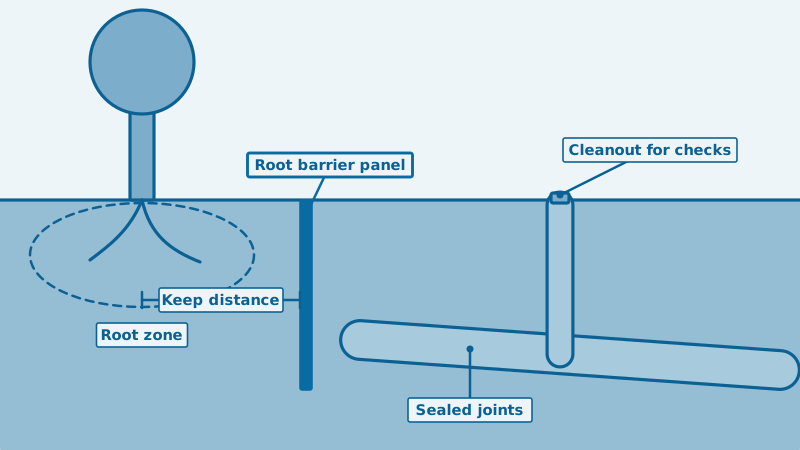
Options once the line is clear:
- Repair the joint or crack where the roots enter.
- Line the pipe, which closes every joint. See sewer pipe lining.
- Replace the pipe if it is failing along its length. See trenchless pipe replacement.
- Keep trees away from the line when planting, and ask before removing a large or protected tree.
Our page on preventing tree roots in a sewer line goes further.
Is a tree root problem in my sewer line covered by insurance?
Often not. Many homeowner policies exclude damage from roots, wear and age, and treat the sewer lateral as the owner's responsibility. Some add an optional sewer or service line endorsement. Read your policy and call your insurer before you pay for repairs, and keep the camera footage and any quotes.
See whether home insurance covers sewer line replacement and whether sewer line insurance is worth it for how these policies usually read.
When should I call someone?
Call when drains back up, when more than one fixture is slow, or when a root treatment has not helped. Roots in a main line almost always need cutting, and a camera shows what is wrong. You can send a quote request, and we'll arrange a visit from a local drain cleaner who gives a written price first. Nothing is done until you agree.
For other services, see the LA Drain Works home page.
Questions people ask
Does Drano or a chemical drain cleaner kill tree roots?
No. Household drain cleaners are made for hair and grease, not roots, and they do not reach roots in the main line. They can also harm old pipes and are risky to handle. A line blocked by roots needs cutting, and a root killer is a separate product with its own label.
How long does copper sulfate take to kill roots?
Days to weeks for the roots it touches to die, and longer for them to break up and wash out. It does not open a blocked line. Many guides suggest treating once or twice a year on a root-prone line, within the label limit. Follow the label, not a general rule.
Is foaming root killer better than copper sulfate?
It is often easier to use and reaches the whole pipe wall, and it avoids copper's wastewater problems. Neither clears a blockage. Both are pesticides with labels, so follow the directions, and keep children and pets away from the area while treating.
Can I kill the tree to stop the roots?
You can, but the roots in the pipe do not stop at once, and the tree may be protected or may belong to a neighbor or the city. Ask before removing one. Killing roots inside the pipe does not repair the opening they used, so the repair is still needed.
Will tree roots damage a lined sewer pipe?
A liner has no joints, so roots cannot enter through its wall, which is the main reason people line root-prone pipes. They can still find weak seals at the ends or branch openings. A camera after lining confirms that the seals are tight.
Sources used
- US EPA, pesticide product label, copper sulfate crystals (EPA Reg. No. 56576-1)
- US EPA, Copper Compounds Interim Registration Review Decision
- US EPA, pesticide product label, Roebic Foaming Root Killer (EPA Reg. No. 7792-7)
- Los Angeles County Public Works, Sewer: owner responsibility for the lateral
- Cured-in-place pipe, method and limits
- Published guidance from several plumbing businesses on root treatment and cutting, checked November 2026
Page updated