Cleaning a sewer pipe means removing whatever narrows it: grease, roots, wipes, scale or a collapsed joint's debris. Soft buildup comes out with a cable or a water jet. Roots need a cutter. A broken pipe cannot be cleaned into health at all, and needs repair. Our overview of sewer cleaning in Los Angeles covers the basics. This page looks at the pipe itself.
What is actually blocking my sewer pipe?
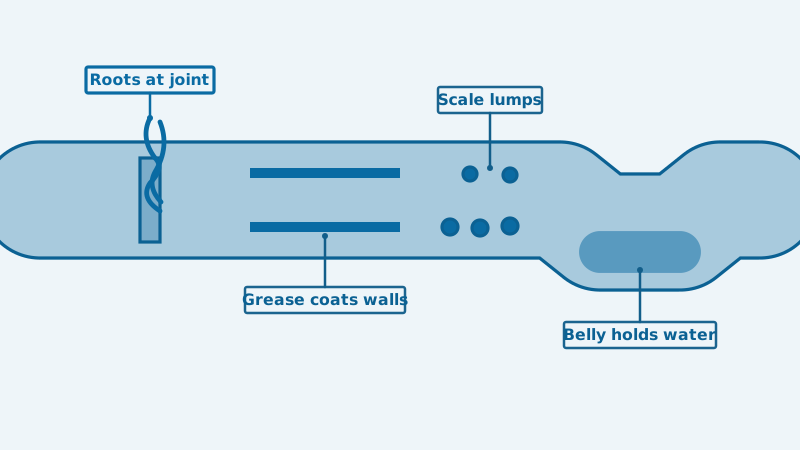
Four things cause most sewer line clog calls in a home: grease that hardens on the pipe wall, tree roots that grow in through joints, flushed wipes and paper products, and a damaged pipe where debris catches. LA Sanitation reports that more than half of the backups it sees come from roots and from fats, oils and grease poured down drains.
Each leaves a different mark, and the mark points to the fix:
- Grease and food residue forms rings that narrow the pipe over months. It is common where kitchen drains are heavily used, and it comes back unless the wall is scoured.
- Roots arrive as hair-like threads that thicken and snag paper. They are the clog people call "a main line problem" that returns every year.
- Wipes and other obstructions form a dam that holds paper behind it. "Flushable" on a wipe package does not mean it breaks up like paper.
- A bellied or cracked pipe holds water at a low spot and collects solids there.
A camera pass tells you which. It is worth asking for, because the wrong tool clears the symptom and leaves the cause.
Does the pipe material change how it should be cleaned?
Yes. Clay pipe has joints that roots exploit and that can crack under an aggressive cutter. Cast iron has a rough, scaled interior that catches debris and can be thin with age. Plastic pipe, such as ABS or PVC, is smooth and tolerates cables and jets well. Which one you have decides how hard a plumber should push.
| Pipe type | What it tends to suffer | Cleaning approach |
|---|---|---|
| Vitrified clay | Root entry at joints, cracks, offsets | Cable with a cutter, then a jet at moderate pressure, camera first |
| Cast iron | Scale, rust, thin walls, slow flow | Jet to descale, gentle cable work |
| ABS or PVC | Rarely roots, mostly grease or objects | Cable or jet, either is fine |
We have not seen a published count of which materials run under Los Angeles streets, so we cannot say how much of the city is clay. In older neighborhoods, a lateral of clay or cast iron is common, and a camera confirms it in minutes. For clay, see our page on old clay sewer pipe.
Which cleaning method suits a sewer pipe: cable or hydro jet?
A cable suits a first-time blockage in a pipe that otherwise flows. A hydro jet suits grease, scale and repeat clogs, because it cleans the whole wall. Many plumbers use both: a cable to open a path, then a jet to finish. Our comparison of hydro jetting versus snaking goes into detail.
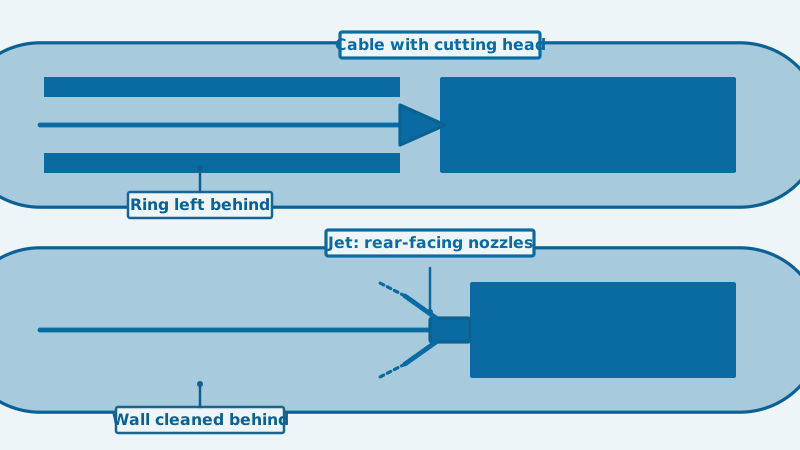
Think of the difference this way. A cable opens a channel through the middle of a blockage and leaves a ring behind. A jet strips the ring. For maintenance on a line with no trouble, a cable is usually enough. For a line that clogs twice in a year, ask what the jet would cost compared to a third cable visit.
Published Los Angeles prices for residential sewer pipe cleaning run roughly $150 to $600 for a cable job and $350 to $900 for jetting, with root-filled lines higher. We cover the full bill in sewer drain cleaning cost.
How often should a sewer pipe be cleaned?
A sewer pipe with no history of trouble does not need scheduled cleaning. A pipe with roots often benefits from a cleaning every one to two years, and a pipe that carries heavy kitchen grease may need jetting more often. Let a camera pass decide the schedule, and avoid cleaning for the sake of it.
Maintenance that does help, between visits:
- Keep grease, coffee grounds and food scraps out of the drain, and wipe pans before washing.
- Flush only toilet paper. Wipes of every kind belong in the trash.
- Know where the cleanout is, and keep it uncovered.
- Watch for early signs: slow drains, gurgling, a faint smell outside.
- Ask for a root treatment after clearing if the camera showed roots.
Can you clean a sewer pipe yourself?
For a short, accessible run, a hand auger through a cleanout can work. A long sewer pipe, a line with roots, or one that has backed up is beyond what a store cable handles safely. Skip chemical cleaners in a sewer pipe: they rarely reach the clog and they leave a hazard for whoever clears it later.
Legally, work on a private lateral is regulated. In California, a project of $1,000 or more in labor and materials needs a contractor with the right CSLB classification, and permits for repairs in Los Angeles are separate. Cleaning alone is less tightly governed than repair, but a contractor should still explain what they will do and what it costs before they start.
If you want a plumber's visit, request a written price. Our home page shows the rest of the drain work we arrange.
Questions people ask
What is the difference between sewer pipe cleaning and drain cleaning?
Drain cleaning clears one fixture or one branch, such as a kitchen sink or a shower, and usually costs less. Sewer pipe cleaning clears the larger line that carries everything from the house to the street. It is longer, deeper and harder to reach, so it takes bigger tools and costs more.
Will cleaning fix a cracked sewer pipe?
No. Cleaning removes buildup but does nothing to a crack, an offset joint or a collapsed section. If a camera shows damage, the line needs repair, lining or replacement. Our guide to pipe lining versus replacement explains the options once you know what the pipe needs.
How long does cleaning a sewer pipe take?
A simple job through an outdoor cleanout often takes one to two hours. A root-filled or long line that needs a cable, a jet and a camera can take half a day. A plumber can give you a firmer window once they know the access point.
What should I ask a business before it cleans my sewer pipe?
Ask what tool they will use and why, whether a camera pass is included, whether the price changes if they have to pull a toilet, and which CSLB classification they hold. Ask for the price in writing before the work starts, and for the video afterward.
Sources used
- LA Sanitation, Managing and Protecting LA's Underground Sewer System
- Los Angeles County Public Works, Sewer
- Drain cleaner, safety and chemistry
- Published prices of Los Angeles drain cleaning businesses, checked November 2026
Page updated