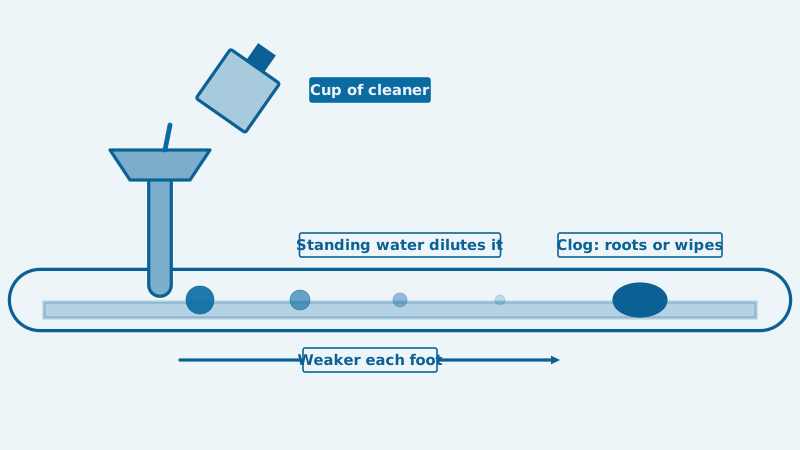
There is no best chemical for a clogged sewer line. A main line is a large pipe carrying a lot of water, so a bottle of cleaner is diluted and washed away before it can act, while still posing a burn and fume risk to you. A plunger at a fixture, then a cable or water jet from a cleanout, clears a main line far more reliably. Our chemical drain cleaning guide explains the products in general; this page is about the main line.
Why don't store-bought chemicals clear a sewer line?
A main sewer line is a 4-inch or larger pipe running tens of feet, often with water standing in it when it is blocked. A cup of cleaner poured at a fixture disperses in that water. By the time it reaches the clog, if it does, it is too weak to dissolve anything.
Commercial chemical openers usually contain corrosive acids or alkalis, according to Wikipedia, designed to break down grease, hair and organic matter in a small pipe near a fixture. A main line clog is often roots, a collapsed section or a mass of wipes, and chemicals do not remove those.
The practical rule: chemicals are for small, slow drains near the fixture, and even there they are the third choice after a plunger and a cable.
What do lye and acid drain cleaners actually do?
Lye cleaners contain sodium hydroxide, which turns grease into soap and can break down hair. Acid cleaners, often based on sulfuric acid, attack organic material and some mineral scale. Both generate heat, both are hazardous to handle, and neither is designed for the large volume of a main sewer line.
Wikipedia notes that sodium hydroxide is highly corrosive, can cause chemical burns and can cause permanent blindness on eye contact. Lye can burn skin and cause severe eye injuries, so follow the label.
Mixing is the greater danger. Never mix cleaning products, and never mix bleach with ammonia or other cleaners. Follow each product label. Acid and alkaline drain cleaners can react together and release heat. If one product fails, do not add another. Scalding water can also come back up the drain.
They also leave a hazard behind. A drain that did not clear is now full of caustic liquid, and a plumber who opens the trap or cleanout may be splashed. Tell anyone who works on the drain what you used.
Do root-killing chemicals clear a sewer line?
They are aimed at roots, not at a blockage, and they work slowly. A foaming root killer is used on a line that is already open enough to let water pass, to stop roots regrowing over months. It does not unblock a line that is fully stopped.
If roots are the cause of the clog, the line needs to be cut open first with a machine or jet, and the chemical applied afterwards as maintenance. Our page on foaming root killer explains what it contains and how it is used. What dissolves tree roots in sewer lines covers the options and their limits.
LA Sanitation links more than half of sewer backups to roots and grease, and says the property owner is responsible for the private lateral from the building to the sewer main. If roots are the problem in your lateral, the fix is on your side of the line.
Is a "professional drain cleaner liquid" better than store-bought?
Professional liquids are usually stronger versions of the same chemistry, often concentrated acid or lye blends, sold for use by trained people. Their strength raises the hazard. Wikipedia notes that augers and high-pressure water carry their own risks, and training matters for all of them.
What a professional adds is not a better bottle. It is a machine, a cable that reaches the clog, a jetter that scours the pipe wall and a camera that shows what is going on. Those tools are not available in a store, and they remove the clog rather than dissolving part of it.
If a professional offers a liquid treatment alone for a main line with water standing in it, ask what it will reach and how they know. A clear answer should mention access, flow and what happens if it fails.
What should I try first instead of chemicals?
Start with the simplest tools and work up. A plunger can clear a clog near a fixture. A hand auger handles sinks, tubs and showers. For the main line, the cleanout is the access point, and a drum machine or a water jet clears the pipe.
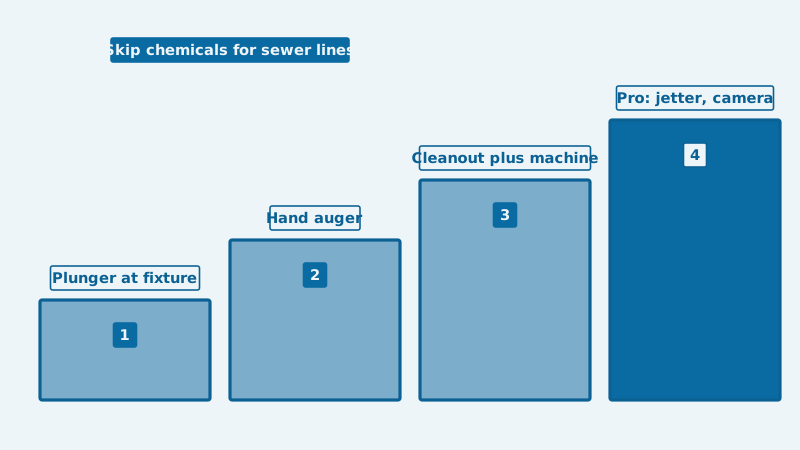
- Check whether more than one fixture is slow, which points to the main line.
- Locate the cleanout, a capped pipe outside the house or in the basement, garage or crawlspace.
- Do not run water into a blocked system.
- Call someone with a machine and a camera for the main line.
If the signs are more urgent, such as sewage in a tub or floor drain, see emergency sewer backup. For the main line itself, how to unclog a main drain line explains the steps, and cleaning a sewer cleanout covers access.
Does Dawn dish soap or boiling water clear a sewer line?
No, not a main line. Dish soap and hot tap water may loosen a light grease film in a kitchen drain. They are not strong enough to move a root mass or a wipe wad in a large line. Boiling water is also a poor idea: Charlotte Pipe lists PVC at a 140 degrees Fahrenheit maximum working temperature.
Dawn is a surfactant, which helps cut grease, so some people find a squirt and a kettle of hot tap water improves a slow kitchen sink. That is the limit of the evidence. For a main line, the same amount of soap is lost in the flow.
Do not trust marketing that says a single bottle clears "any clog". Judge a product by whether the drain flows faster after a fair trial, and stop if it does not.
How do I dispose of leftover drain chemicals?
Do not pour them down a drain or put them in the trash. LA Sanitation's S.A.F.E. centers take household hazardous waste, and residents of Los Angeles County can use them for free. Check the accepted items and hours on the official page first.
Keep the product in its original container, upright and sealed, away from other cleaners and out of reach of children and pets until you can drop it off. If anyone is exposed to fumes or a splash, move to fresh air and call Poison Control at 1-800-222-1222.
When should I call someone for a clogged sewer line?
Call when more than one fixture is slow or backing up, when you hear gurgling from drains, when a toilet bubbles as other fixtures run, or when sewage appears at a floor drain. Do not wait for a chemical to work.
We'll arrange a local drain cleaner with a machine or jet for the main line, and the written quote arrives before any work. A plumber for a main line clog is the usual service, and a camera shows the cause. Send a price request and say what you have already poured in. The LA Drain Works home page lists the other jobs we arrange.
Questions people ask
What is the strongest thing to unclog a drain?
Mechanically, a motor-driven cable or a high-pressure water jet. Chemically, a concentrated lye or acid product is the strongest, but also the most dangerous, and it rarely reaches a main line clog. For a sink or tub, a plunger and a hand auger come first.
Does Dawn dish soap unclog drains?
It can help with a light grease film in a kitchen sink when used with hot tap water. It does not break up hair, roots or a solid plug. Treat it as a gentle first step, not a fix. If the drain does not improve, switch to a plunger or cable.
Is Dawn dish soap good for clogged drains?
It is good at cutting grease and safe for skin and pipes, so it is a reasonable first try on a slow kitchen drain. It is not good for a fully blocked drain or a main line. Do not rely on it for roots or deeper problems.
Does Dawn dish soap clog drains?
Not in normal use. Dish soap is designed to rinse away, and a small squirt with hot tap water should flow through. The grease it loosens can set again farther down the line if it cools, which is why a slow kitchen drain sometimes returns.
What should I ask before hiring for a sewer line clog?
Ask which machine they use on a main line, whether a camera is included when the cable does not clear it, and whether the price is written before work. Mention any chemical you poured in. Ask what happens if the clog returns within weeks.
Sources used
- Wikipedia, drain cleaner
- Wikipedia, sodium hydroxide
- Poison Control, household product safety, 1-800-222-1222
- Charlotte Pipe, PVC maximum working temperature (140 F)
- LA Sanitation and Environment, protecting the city's sewer system (private laterals, roots, grease)
- LA Sanitation and Environment, S.A.F.E. centers for household hazardous waste
Page updated