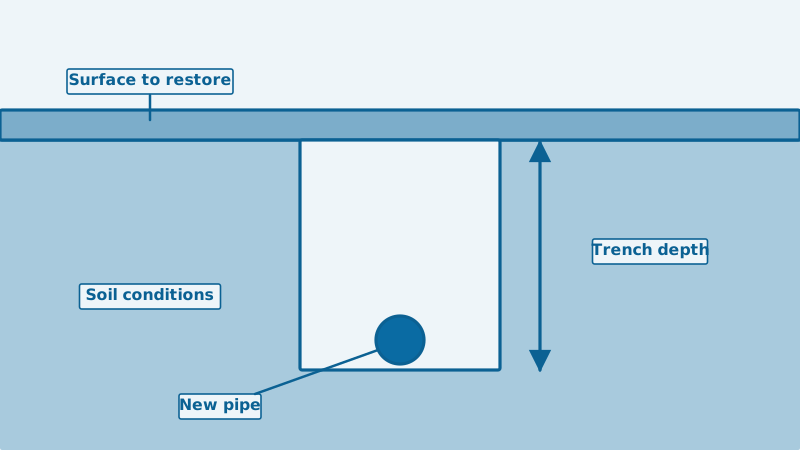
Replacing the sewer lateral, the pipe that runs from your house to the city main, usually costs $5,000 to $15,000 in Los Angeles. The figure moves with the length of the run, how deep it sits, what lies on top of it, and whether the work is trenchless sewer repair or an open trench. A short, shallow line under a lawn lands at the bottom. A long line under concrete lands at the top and sometimes beyond.
Every figure below comes from published prices, not from a quote. Treat it as a guide for budgeting, then ask for a written quote for your own line.
How much does it cost to replace laterals?
Published Los Angeles figures put whole-lateral replacement at about $5,000 to $15,000, with $80 to $300 per linear foot as the working range. Open-trench work sits at the cheaper end per foot. Trenchless sewer line replacement costs more per foot but spares the driveway, patio and landscaping, which is where open-trench bills grow.
| Method | Typical price per foot | What it means for a 50-foot run |
|---|---|---|
| Open trench, digging up the old pipe | $50 to $250 | $2,500 to $12,500 before surface repair |
| Pipe bursting, pulling new pipe through the old | $80 to $300 | $4,000 to $15,000 |
| Cured-in-place lining, a resin liner inside the old pipe | $80 to $250, with a California lining contractor at $120 to $250 | $4,000 to $12,500 |
| Spot repair of one failed section | $1,500 to $5,000 per repair, not per foot | One dig, one section |
Fifty feet is only an example. We do not have a figure for the length of a typical Los Angeles lateral, so measure from the cleanout to the street connection, or have a camera run find the length.
Permits come on top. Published Los Angeles figures range from about $150 to $1,000 or more, depending on whether the work stays on your lot or reaches the public right-of-way. One contractor's summary of the building department schedule lists a $215 permit fee plus a $185 plan check for a private-property lateral permit. Fees change, so confirm with the department that issues yours.
What is the cheapest way to replace a sewer line?
The cheapest honest route is whichever method matches the damage. A single cracked section can be fixed with a spot repair for roughly $1,500 to $5,000. A long, straight, uncomplicated run under bare soil is often cheapest as an open trench. Trenchless wins once concrete, mature landscaping or a hillside would turn digging into a restoration project.
Price per foot is a poor way to compare. Ask for the total, with surface repair listed as a line item. A low trench price that leaves you to rebuild a driveway is not the cheaper job.
Lining is the other low-cost route when the old pipe still holds its shape. Lining a pipe that has collapsed or sagged does not work, because the liner follows the shape of the pipe it goes into. A camera inspection settles this before anyone commits, and our page on camera drain inspection costs shows what that step runs.
Is replacing a sewer line covered by homeowners insurance?
Usually not. A standard California homeowners policy generally excludes sewer and drain backup, and it does not pay to replace a worn or root-damaged pipe, which is treated as maintenance. A water backup endorsement can cover damage inside the house after a backup. It rarely pays for the lateral itself.
Read your own policy or ask your agent, because wording and limits differ. Endorsement prices quoted by agents run from tens of dollars to a couple of hundred dollars a year, with limits that a serious backup can exceed. If a sewage backup has already damaged floors and walls, the cleanup claim and the pipe replacement are separate questions. Our main sewer line clog cost guide covers the cleanup side.
Can you repair a sewer line without digging it up?
Yes, when the pipe is still roughly round and continuous. Trenchless sewer line replacement uses pipe bursting, which breaks the old pipe and pulls a new one into its place, or lining, which cures a new pipe inside the old one. Both need only small access pits, usually at the cleanout and near the street connection.
Neither suits every line. Heavy sags that hold water, a collapsed section, or a pipe offset badly at a joint usually means digging at that spot. In Los Angeles, many older laterals are clay, cast iron or Orangeburg, the bituminized fiber pipe common in postwar homes, and sources say Orangeburg lasts only 30 to 50 years. Orangeburg tends to flatten, which makes lining harder and pushes some jobs toward bursting. Only footage from a camera tells you which applies. Our guide to how trenchless repair works walks through both methods.
Does replacing a sewer line increase home value?
We could not find a verified Los Angeles figure for resale value, so we will not invent one. What we can say is that a failing lateral shows up in a buyer's camera inspection, and a documented, replaced line removes a negotiating point and a source of risk.
Treat the work as protection against a backup and as a cleaner sale, not an investment with a return you can count on. If you are selling, ask the buyer's side what the inspection report flagged before spending money.
What pushes the price of a sewer line replacement up or down?
Length and depth do most of it, because crews bill by the hour and every extra foot means more excavation or more pipe. Surface matters next. Concrete, pavers and mature trees add demolition and repair. Hillside lots add access problems. Permits, a failed first camera pass and an extra pit all raise the total.
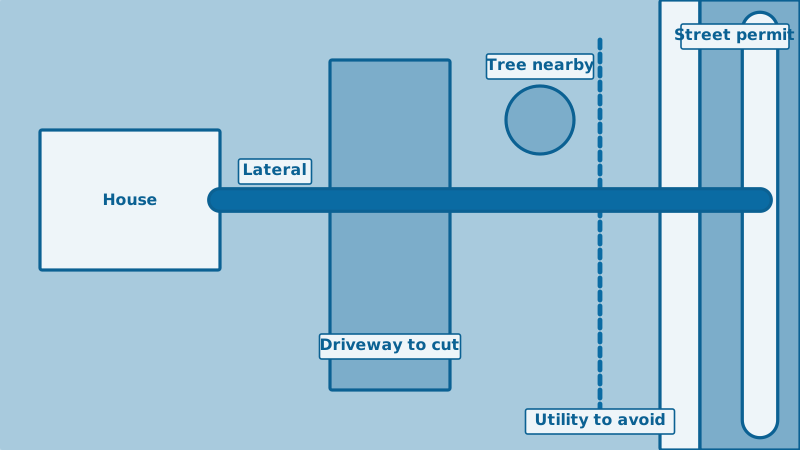
Pricing on the low side usually comes from:
- a short run to a nearby main
- soft ground with nothing built over it
- one clean access point at each end
Pricing on the high side usually comes from:
- long runs, or runs under a house or slab
- work in the public right-of-way, which needs a separate city permit
- a collapsed pipe that rules out trenchless methods
Who is responsible, and who is allowed to do the work?
In Los Angeles County and the City of Los Angeles, the property owner is responsible for the whole lateral, including the part under the street. Both agencies say so on their sewer pages. The public main belongs to the city or county. Because the lateral serves one property, the city says it does not fund repairs on it.
Permits depend on where the work is. Work on your lot goes through the building department. Work in the street or sidewalk needs an S-Permit from the Bureau of Engineering, issued to a Bonded Sewer Contractor. The state contractor board's own guidance says holders of a general engineering (A), pipeline (C-34), plumbing (C-36) or sanitation system (C-42) license can install building sewers. Ask any bidder for their CSLB license number and check it on the board's site before you sign.
Request a written price through the price request form and tell us the street, the age of the house, and whether the line runs under concrete.
How do you compare sewer line replacement quotes fairly?
Put every quote on the same footing: method, footage, depth, who pulls the permit, what surface repair is included, and what happens if the crew finds something unexpected. Two quotes with the same total can cover very different jobs. A quote that will not say the footage is a quote you cannot check.
Ask each bidder for these in writing:
- The pipe material and diameter being installed
- The footage and the camera findings behind it
- Permit fees and who handles inspection
- Concrete, landscaping and driveway repair, included or not
- A clean-out installed or kept at the house end
The home page has more on how we arrange visits across the Los Angeles area.
Questions people ask
What is the average lifespan of a sewer line?
It depends on the material. Orangeburg fiber pipe is reported to last 30 to 50 years. Clay and cast iron often last far longer, but root intrusion at clay joints and rust in cast iron can end their useful life early. A camera inspection shows the actual condition, which matters more than the age of the house.
Can a homeowner replace their own sewer line?
Not realistically in Los Angeles. The work needs excavation, a permit, an inspection, and correct slope and fittings. Anything in the street or sidewalk needs a Bureau of Engineering permit that homeowners are not set up to pull. Mistakes mean a backup into your own house. Hire a contractor and check their CSLB license.
What is the difference between sewer line repair and replacement?
Repair fixes a section, typically a cracked or offset spot, for about $1,500 to $5,000. Replacement renews the whole run. If a camera shows one defect in otherwise sound pipe, repair makes sense. If it shows cracks, sags or roots along the length, patching one spot only moves the failure down the line. See sewer line repair costs.
Are there grants for sewer line replacement in Los Angeles?
LA Sanitation states that the city does not provide financial assistance for lateral repair or replacement. We have not found a general grant program for private laterals. Some homeowners finance the work through their contractor or a home equity product. Ask the city or county about any program that applies to your address before you assume none exists.
How much does a sewer line permit cost?
Published Los Angeles figures range from about $150 to $1,000 or more. One contractor summary lists $215 plus a $185 plan check for private-property lateral work. Work in the public right-of-way is permitted separately. Fees change, so ask your contractor which permit applies and confirm the current fee with the issuing department.
Sources used
- Los Angeles County Public Works, Sewer: owner responsibility for the lateral
- LA Sanitation, Managing and Protecting LA's Underground Sewer System
- CSLB, C-36 Plumbing Contractor classification
- CSLB, C-42 Sanitation System Contractor classification
- Published prices and cost guides from Los Angeles plumbing businesses and national cost sites, checked November 2026
Page updated