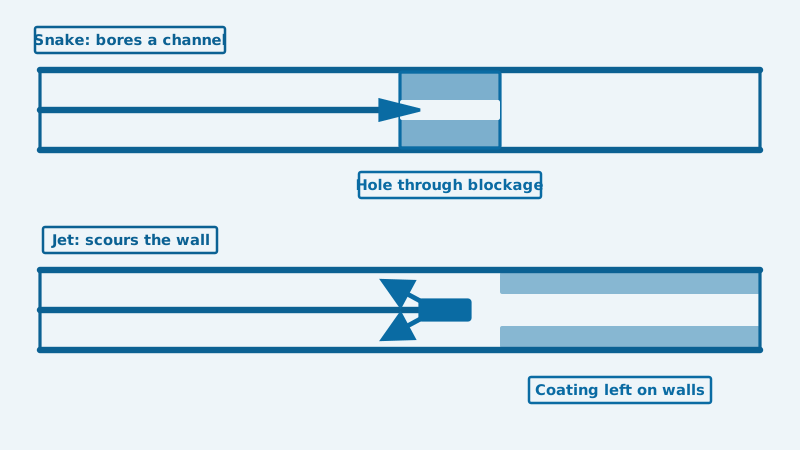
Snaking pushes a rotating steel cable into the pipe and breaks or hooks the clog. Hydro jetting fires high-pressure water through a hose and scours the whole pipe wall. Snaking is quicker and cheaper for a single stoppage in a sink, tub or toilet. Hydro jetting costs more but is the better choice for grease, roots and repeat backups in the main line. It is part of our hydro jetting drain cleaning work, and below is how to choose between the two.
What is the difference between hydro jetting and snaking?
A snake, also called an auger or drain cable, bores through the blockage and leaves a channel the width of the cable. A hydro jet uses a nozzle on a flexible hose to blast water at the walls and pull itself forward, cutting and flushing what it meets. One opens a path, the other restores the pipe's bore.
That matters because a cable often leaves most of the buildup on the pipe wall. Water flows again for a while, then the sludge closes in around the new hole. A jetter takes the wall back toward bare pipe. Wikipedia's entry on the plumber's snake covers the hand and machine versions in more detail.
The equipment also differs. Cables run from a hand crank for a sink to a drum machine for a main line. Jetters are truck or trailer mounted units with a pump, a water tank or hose supply and a selection of nozzles.
When is snaking the right choice?
Snaking is the right choice when one fixture has stopped and the cause is probably soft and close to the drain: hair, soap, a toy or a wad of paper. A hand auger or a small machine reaches that in minutes, and costs the least. National guides put a plumber's snaking of a single fixture at about $100 to $300.
Snaking also suits a first look at a line you know little about. A cable gives the operator a feel for where the blockage sits and what it is made of. If it comes back with roots or grease on the tip, that is your cue that a jetter or a camera is the next step.
Cables have limits. In a pipe with a bend or a belly they can coil and stall. In an old fragile pipe the cutting head can catch on a joint. If you have a repeat stoppage, read why a drain is still clogged after snaking.
When does hydro jetting do a better job?
Hydro jetting does better when the problem is buildup rather than a plug: grease coating a kitchen line, scale, soap and hair lining a long run, or fine roots threading through clay joints. The water flushes debris downstream rather than leaving it behind. It is also the usual choice for a main line that has backed up more than once.
Residential jetters commonly work between about 1,500 and 4,000 psi of water pressure, according to the price guides we checked. Commercial units go much higher. A trained operator sets the pressure to the pipe, not to the maximum.
A second reason is the water flow itself. Jetting leaves the pipe bore as large as it was built, so waste moves at its designed speed. After a cable pass, the pipe can stay partly coated and narrower than it was built. For a restaurant or a building with many fixtures on one line, that difference shows up in how often it clogs.
Is hydro jetting safe for old pipes in Los Angeles?
Not always. Los Angeles has many clay laterals, cast iron stacks and, in some homes built between roughly the 1940s and early 1970s, Orangeburg pipe, a tar and wood pulp material that softens with age. Water at high pressure can enlarge a crack, break a collapsed joint or wash away soil around a damaged section.
That is why a good operator runs a camera first and picks the nozzle and pressure from what it shows. If the pipe is fragile, a cable or a lower pressure pass may be the safer first step, and repair or lining may be the real answer. Our guide to pipe lining versus replacement covers what comes next.
Roots are a special case. LA Sanitation says the owner maintains the private lateral, roots included, even when they come from a public tree. A jetter with a root cutting nozzle trims the roots, but they grow back without a repair or regular treatment.
What does each one cost?
Plan on roughly $100 to $300 to snake a single fixture and $150 to $500 to snake a main line. Hydro jetting runs roughly $350 to $900 in most guides, and higher figures appear for long or root-heavy lines. West Coast costs tend to run above the national figures. Your written quote after a visit is the price that counts.
| Job | Typical range (national guides) | What moves it |
|---|---|---|
| Snake a sink, tub or toilet | $100 to $300 | Access, how deep the clog sits |
| Snake a main line | $150 to $500 | Cleanout access, length |
| Hydro jet a main line | $350 to $900 | Length, roots, grease, access |
| Camera inspection before jetting | $125 to $750 | Length, recording, locating |
Snaking is not always the cheaper choice over a year. If you pay for three snakings in a season, a single jetting and a camera can cost less. See drain cleaning cost and hydro jetting cost for the full breakdown.
Which one should I choose for my drain?
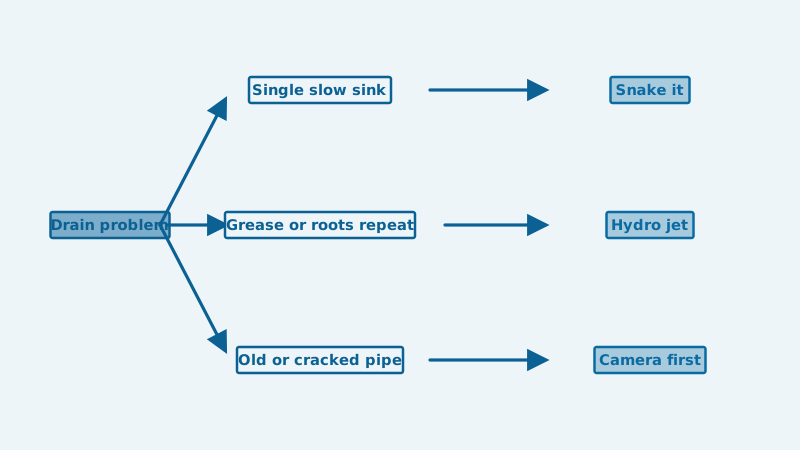
Choose snaking for a single slow fixture, a recent stoppage and a modern pipe. Choose hydro jetting for grease, roots, repeat clogs, a main line, or any building with many fixtures on one line. When you cannot tell, a camera visit costs little compared with paying for the wrong method twice.
Our default order of events is simple: describe the problem on the quote page, we arrange a local drain cleaner, and they decide on site after looking in the pipe. The LA Drain Works home page lists the other services, from camera work to sewer repair.
Questions people ask
Does hydro jetting damage pipes?
On sound pipe at a sensible pressure, no. On cracked, collapsed or very old pipe, it can make damage worse. That is why a camera look comes first on older lines. A good operator adjusts the nozzle and pressure to the pipe's condition and stops if the picture is poor.
Is hydro jetting better than snaking?
For buildup, grease and roots it usually is, because it cleans the pipe wall. For a single local plug in a modern drain, snaking is faster and cheaper. Neither is better in every case, and the right choice depends on the pipe and the cause.
Can I hydro jet my own drains?
Home pressure washer drain kits exist, but they run at much lower pressure than a professional jetter, and it is easy to push sewage back into the house or stall a hose. Our guide to hydro jetting tips covers what a home unit can do and when to stop.
How long does each take?
A fixture snaking is often a short visit. A main line jetting, with a camera run before and after, takes longer. Time depends on length, access and how heavy the buildup is. Ask for an estimate when you request the quote.
Do I need to be home?
Someone needs to give access to the cleanout, the fixtures and sometimes the roof. You do not need to be present for the whole job, but an adult should be reachable to approve any change to the quote. Say at booking how access works, whether through a gate, a yard or a roof.
Sources used
- HomeGuide, hydro jetting cost (2026)
- HomeGuide, cost to unclog or snake a drain (2026)
- Wikipedia, Orangeburg pipe
- LA Sanitation, managing and protecting LA's underground sewer system
- Published 2026 price guides for snaking and jetting, checked November 2026
Page updated