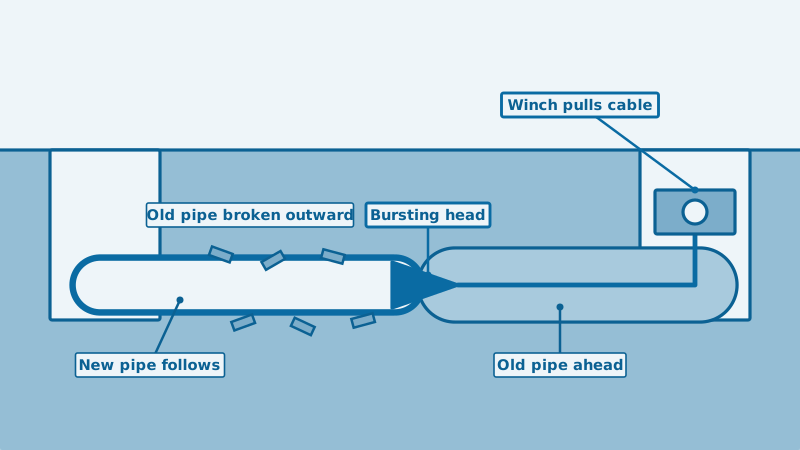
Trenchless pipe replacement means installing a new pipe along the path of the old one without opening a trench the whole way. The usual method is pipe bursting: an expander head is pulled through the old pipe, breaking it outward, while new pipe follows behind. Only a pit at each end is dug. It protects lawns, driveways and landscaping, but it needs a pipe that suits it and a crew that has done it before. Our hub on no dig sewer line repair covers all the trenchless options.
What is trenchless pipe replacement?
It is replacing a buried pipe with a new one while digging little more than an entry pit and an exit pit. In pipe bursting, a machine in one pit pulls a cone-shaped head through the old pipe, which shatters or splits it and pushes the pieces into the soil. The new pipe, usually plastic, is pulled in right behind.
The new pipe is a true replacement, not a liner. It has its own wall, it is jointed far less than the old line, and it can sometimes be a size larger than what it replaces. Published descriptions note that pipes up to large sizes have been replaced this way, though a house lateral is a small job by comparison.
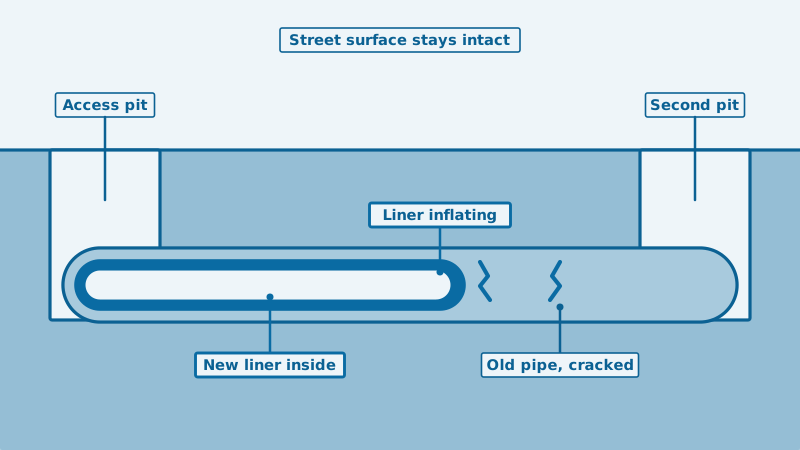
Trenchless is a family of methods. Lining, which seals the old pipe from inside, is also trenchless but does not replace it. If you are unsure which you are being quoted, ask. See sewer pipe lining for the other approach.
How does trenchless sewer pipe repair work, step by step?
A crew cameras the line, digs the launch and receiving pits, feeds a cable through the old pipe, attaches the bursting head and new pipe, then pulls it all through with a hydraulic machine. Connections are rejoined, the line is tested and recorded on camera, and the pits are backfilled and restored.
The sequence for a typical house lateral:
- Camera. Confirms the pipe's path, depth and condition.
- Locate utilities. Gas, water and power lines near the path must be marked.
- Dig pits. One near the house or cleanout, one near the street or the far end.
- Pull the cable. Attach the head and the new pipe.
- Burst and pull. The machine draws the head through, breaking the old pipe.
- Reconnect. Tie in the house drain and the main.
- Test and camera. Check the grade and joints, and keep the recording.
- Backfill and repair. Restore the pits.
Our guide on how trenchless sewer repair works goes deeper on each stage.
What are the disadvantages of trenchless pipe replacement?
The main ones: it needs pits and clear utilities, it cannot always follow a line that has sagged or bent sharply, it can disturb the ground and nearby pipes, and it can cost as much as a trench on a short, shallow run. Early bursting heads sometimes lost their path, which is why experience matters.
The practical downsides:
- Pits are still needed. There is less digging, not none.
- Utilities. Pipes and cables close to the old line can be damaged by the head or by ground movement, so locating is essential.
- Soil. Published material notes that ground type and surface loads matter, and a shallow pipe under heavy traffic needs care.
- Old grade problems stay. The new pipe follows the old path, so a belly in the old line can remain unless the pit work corrects it.
- Not for every pipe. A pipe that has partly collapsed with a sharp bend may defeat the head.
- Cost. On a short run in open lawn, a plain trench can cost the same or less.
- Experience. Quality depends on the crew. Ask how many they have done.
None of this is a reason to avoid it. It is a reason to ask for the camera footage and the method's fit before you agree. Our page on pipe lining versus replacement compares the two in more detail.
When is trenchless replacement the right choice?
When the pipe has failed so much that lining will not work, when there is surface worth protecting, and when the line is reasonably straight. A collapsed clay pipe under a driveway is a good case. A cracked pipe still round and open is better lined. A short, shallow line in bare soil is often cheaper to dig.
| Situation | Better choice |
|---|---|
| Collapsed or crushed pipe under paving | Trenchless replacement, or open trench |
| Orangeburg that has flattened | Replacement, by bursting or trench |
| Round pipe with root trouble at joints | Lining |
| Short, shallow run in bare soil | Open trench |
| Pipe with a sharp bend or an offset | Open trench, or a repair first |
If the old pipe is clay, see old clay sewer pipe and repairing clay sewer pipe for how it breaks and which fixes suit it.
How much does trenchless sewer pipe replacement cost?
Published guides put pipe bursting at about $60 to $200 per foot, and a replacement of a typical 50 foot lateral at roughly $6,000 to $13,000 in Southern California business listings. The figure goes up with depth, length, difficulty and surface repair. A written quote after a camera look is the real price.
The comparison that matters is the total, including restoration. A trench through a driveway needs concrete cutting and pouring, and bursting usually does not. For the detail, read sewer line replacement cost and sewer pipe lining cost per foot.
How do I choose a trenchless sewer repair company in Los Angeles?
Pick one that cameras the line first, explains why a method fits, holds the right California license, and pulls the permits. In California, plumbing, sanitation system, pipeline and general engineering contractors may install or repair building sewers, according to the state contractors board. Check the license on the board's website, and ask to see work like yours.
Los Angeles specifics: the owner is responsible for the whole lateral, including the part under the street, according to Los Angeles County Public Works. Work in the public right of way needs a city permit issued to a bonded sewer contractor, and private-side work generally needs a plumbing permit.
Questions to put to any company:
- What did the camera show, and why is trenchless right for this pipe?
- How many pits, where, and who restores them?
- Who pulls permits and handles inspections?
- What is the warranty, in writing?
- What would the open trench price be, for comparison?
Our page on sewer line replacement contractors goes through the license and quote checks in full.
You can send a quote request, and we'll arrange a visit from a local drain cleaner who looks at the line and gives a written price. Nothing is done until you agree. The LA Drain Works home page lists the other work we arrange.
Questions people ask
Is trenchless pipe replacement better than digging?
It is better when it avoids damage to paving, landscaping or trees and the pipe suits it. It is not better on a short, shallow run in open ground, where a trench may cost the same or less. The camera and a price for each method give the answer for your line.
How long does trenchless pipe replacement take?
A typical house lateral can be done in about a day or two, after permits and utility marking. Long runs, deep pits or repairs before the work take longer. Open trench usually takes longer because of the digging and the surface restoration afterward.
Can trenchless methods fix a collapsed pipe?
Pipe bursting can replace a collapsed pipe, since it breaks the old pipe anyway, as long as the head can pass through and the path is straight enough. Lining cannot go through a collapse. The camera shows how far it goes, and a crew may have to dig at the worst point.
Will trenchless replacement damage my other pipes?
It can if utilities run close to the old line, which is why locating them first matters. Ask the company how they mark and clear gas, water and power lines, and how far the pits are from them. A careful crew will have a plan for this.
What is the difference between pipe lining and pipe bursting?
Lining coats the inside of the old pipe with a resin tube, and the old pipe stays in the ground. Bursting breaks the old pipe and pulls in a new one. Lining needs a pipe that is still open and in place. Bursting handles pipes that are failed or collapsed.
Sources used
- Pipe bursting, process and equipment
- Trenchless technology, methods and soil limits
- Cured-in-place pipe, method and limits
- Los Angeles County Public Works, Sewer: owner responsibility for the lateral
- CSLB, Building Official Information Guide, who may install or repair building sewers
- Angi, sewer line replacement cost guides (2026), per-foot figures
- Published trenchless prices from several California plumbing businesses, checked November 2026
Page updated