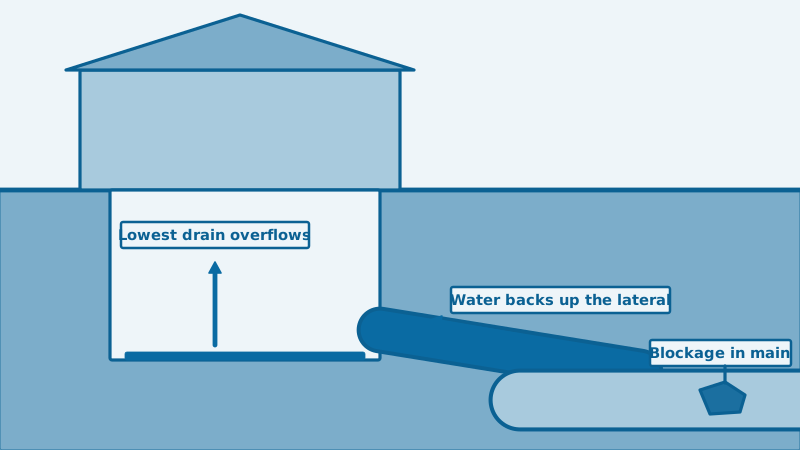
If sewage is coming up through a tub, shower or floor drain, the main sewer line is almost certainly blocked below the house. Stop all water use, keep people and pets out of the wet area, and ask for a visit right away. A main line drain cleaning visit opens the blockage, and a camera shows why it formed. This page walks through what to do before anyone arrives, whose pipe it is, what the clearing costs, and what to do about the mess.
What should I do the moment sewage starts backing up?
Stop using every fixture, including toilets, sinks, the dishwasher and the washing machine. Every gallon you send down has nowhere to go and ends up on your floor. Keep children and pets away from the wet area, switch off power to anything standing in water, and ask for a visit.
Then work through this short list while you wait:
- Note which drains are affected. If the lowest drain in the house is the only one backing up, the blockage is probably in the main line. If one sink is slow and nothing else is, it is a local clog.
- Open the cleanout cap if you know where it is and can reach it safely. Many homes have one near the front of the house or along a side wall. If sewage rises or pours out, the blockage is downstream of that point.
- Photograph the affected areas for your records, before you clean anything.
- Do not pour chemical drain cleaner into a drain that is full of sewage. It will not reach the blockage and it makes the water dangerous to handle.
You can schedule service online by describing what you see. The form allows you to add the address area and any access problems, such as a locked gate or a steep hillside driveway.
Whose pipe is it, the city's or mine?
The sewer main under the street belongs to the city. The pipe from your house to that main, called the lateral, is private. LA Sanitation says property owners are responsible for maintaining and repairing the whole lateral, even when roots come from a public tree. LA County Public Works takes the same position for unincorporated areas.
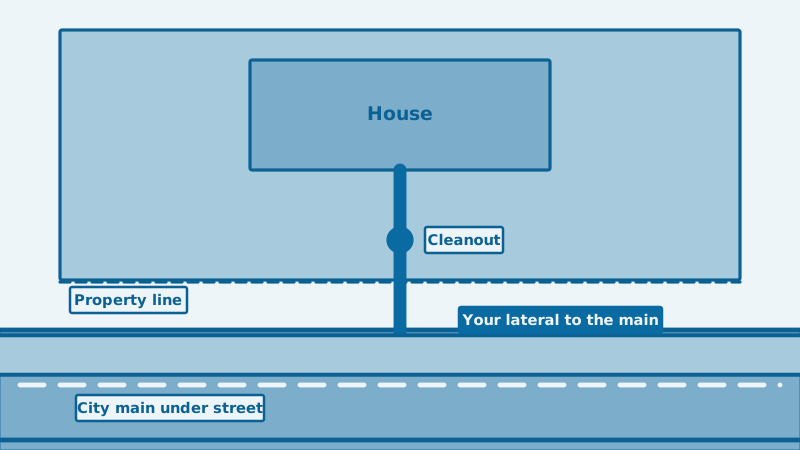
That split decides who to call. Sewage coming out of a manhole or street cover, or several neighbors backing up at once, points to the city main. Call LA Sanitation's 24 hour customer care line, 1-800-773-2489, which the city lists for sewer odor and service reports. If it is only your house, the blockage is nearly always in your lateral, and clearing it is your cost.
A camera run settles the question. It shows whether the blockage sits on your side of the property line, and it gives you a recording to show the city if it does not.
What causes a main line to back up in an older Los Angeles house?
Tree roots, collapsed or offset pipe, and grease are the usual causes. Older Los Angeles homes often have clay laterals with joints every few feet, and roots find those joints. Homes built from the 1940s to the early 1970s may also have Orangeburg, a tar and wood pulp pipe that softens with age and can deform without warning.
Wikipedia's entry on Orangeburg pipe describes a useful life of about 50 years, with failures reported as early as 10. Home age alone does not tell you the material. A camera does.
Other common causes in the trade are wipes sold as flushable, grease that cooled and set in a horizontal run, and sagging sections where the pipe has settled and holds water. Each one leaves a different picture on camera, and each calls for a different fix.
What will clearing an emergency backup cost?
National price guides put snaking a main line at roughly $150 to $500 and hydro jetting at roughly $350 to $900, with a camera inspection adding about $125 to $750. West Coast prices tend to run higher, and an after hours visit often adds a surcharge. Treat these as a guide: the written quote after the visit is the real price.
What moves the number:
- Method. A cable can open a soft blockage. Roots and heavy grease often call for a jetter, which cleans the pipe wall rather than punching a hole through the blockage.
- Access. A reachable cleanout is cheaper to work from than a roof vent or a toilet that must be pulled.
- Time of day. Nights, weekends and holidays are priced differently by most drain businesses.
- Follow up. A camera run after clearing tells you whether it will come back.
We arrange a local drain cleaner who gives you a written quote before work starts. Nothing is done until you say yes. For comparison figures on the other methods, see drain cleaning cost and hydro jetting cost.
Is the sewage dangerous, and how do I handle the mess?
Raw sewage can carry bacteria and viruses, so treat every wet surface as contaminated. The CDC advises rubber boots, rubber gloves and goggles for sewage contact, washing any cuts with soap and water, and drying the area within 24 to 48 hours to limit mold. Porous materials soaked with sewage, such as drywall, insulation and carpet, are usually thrown away.
Hard surfaces can be washed, rinsed, then disinfected with a diluted bleach solution. Never mix bleach with ammonia or acidic cleaners. Wash the clothes you wore separately in hot water.
For a large spill, a restoration company is usually the right call, and that is separate from the drain clearing. Our guide to cleaning up after a sewer backup covers the order of work.
Will my insurance pay for it?
Many standard California homeowners policies leave out sewer and drain backup unless you added a water backup endorsement. Check the declarations page for wording like "water backup" or "sump overflow". Even with the endorsement, the lateral itself is usually not covered. Ask your insurer before you throw anything away, and keep your photos.
Our page on whether home insurance covers sewer backup explains the usual wording. Policies differ, so read yours or ask your insurer.
How do I stop it happening again?
Find the cause, then fix it. A camera run after clearing shows roots, offsets, belly sections or grease, and each has a different remedy: scheduled jetting for roots and grease, a spot repair or lining for a damaged section. Keep wipes, grease and paper towels out of the drains, and keep the cleanout accessible.
Read how to prevent a sewer backup for the home habits that matter, and sewer camera inspection for what the recording will show you. The LA Drain Works home page lists the other services.
Questions people ask
Can I use the toilet or shower while I wait for someone to arrive?
No. Any water you send down a blocked main line will rise at the lowest opening, usually a tub, shower or floor drain. Hold off on laundry and the dishwasher as well. If you absolutely need the bathroom, use a neighbor's until the line is open.
Can I fix a sewer backup myself?
You can check the cleanout and clear a small local clog with a plunger or hand auger. A main line blockage, especially roots or collapsed pipe, needs a machine and often a camera. Rental machines work for some soft blockages, but they can snag in a damaged pipe and make the repair larger.
Does a sewer backup mean I need a new sewer line?
Not usually. Most backups are blockages from roots, grease or wipes, and clearing them restores flow. Replacement or lining is considered when a camera shows a collapsed, cracked or badly offset pipe, or when the blockage returns within weeks. The recording lets you decide with facts.
Will a camera inspection be needed?
It is strongly worth it after an emergency clearing. The recording shows whether the pipe is sound, where the problem sits and whether the city's section is involved. It also gives you something to show an insurer or the city.
Who do I call if the sewage is in the street?
Call LA Sanitation's customer care line at 1-800-773-2489. A street level overflow points at the city's main, which the city maintains. If it is also backing up inside your home, tell them, and arrange a visit for your own lateral at the same time.
Sources used
- LA Sanitation, managing and protecting LA's underground sewer system
- LA County Public Works, who is responsible for sewer repairs
- CDC, guidelines for cleaning safely after a disaster
- HomeGuide, cost to unclog or snake a drain (2026)
- HomeGuide, hydro jetting cost (2026)
- Published 2026 price guides for main line clearing and camera inspection, checked November 2026
Page updated