Lancaster has 55,273 homes, about 70 in 100 of them standalone houses, and the typical home was built in 1986. That is newer than the coastal cities on our areas page, and the differences go deeper than age. The ground here has settled, the winters freeze, rain is scarce and the sewer is run by the city itself. Start with who runs it.
Who runs the sewer in Lancaster?
The city does. Lancaster's Utility Services Division operates and maintains the sewer collection system, which serves every property inside the city limits. The city's pages put it at about 429 miles of sewer and 8,965 manholes. Before July 2008 the county's Consolidated Sewer Maintenance District looked after it.
Wastewater leaves the city for regional treatment run by the Sanitation Districts of Los Angeles County, including the Lancaster Water Reclamation Plant. I could not find a Lancaster page that spells out lateral responsibility. LA County Public Works says the owner is responsible for the lateral, and that is the general rule across Los Angeles County, but confirm the boundary for your address with the Utility Services Division before you argue with anyone over a bill.
Is the ground in Lancaster really sinking, and does it matter for drains?
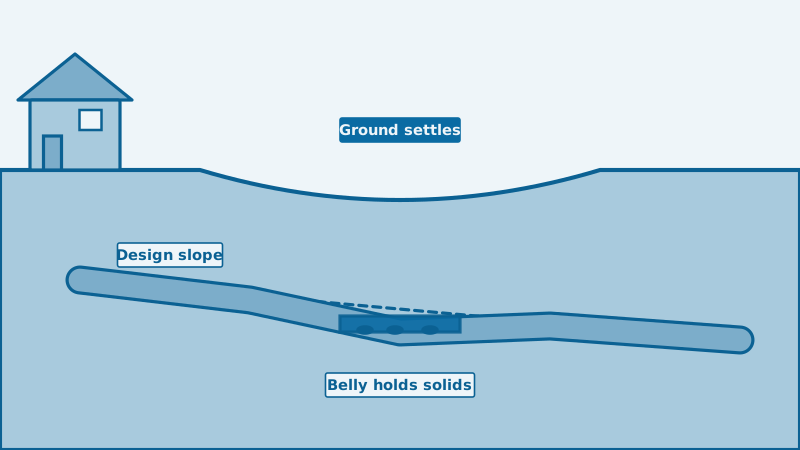
In places, yes. USGS studies of the Antelope Valley describe subsidence from decades of groundwater pumping. Most has happened around the Rogers and Rosamond dry lakebeds just north of Lancaster. A USGS model puts total subsidence through 2005 at about 9.4 feet at its maximum in the Lancaster subbasin, and pumping has also opened earth fissures in Lancaster.
The same model projects more than 3 feet of additional subsidence in central Lancaster under continued pumping. Those figures are model results, not surveys of your street.
A sewer relies on slope. Uneven settling can flatten a grade or leave a low spot where water and solids sit, which is called a belly. I think that is a plausible cause for repeat blockages in a newer Lancaster house with no roots, but I have not seen data that links the two, and only a camera shows it. If footage shows standing water in the pipe, a belly is the likely story, and pipe lining versus replacement matters, since lining does not fix a sag.
Does Lancaster's cold weather freeze drains?
Drains themselves rarely freeze, since buried sewer pipes sit below the cold, but exposed pipes can. The National Weather Service has said Antelope Valley nights run colder than the rest of the region because wind-sheltered air cools by radiation. Lancaster dropped to 22 degrees on November 26, 2023, according to the National Weather Service, which advised wrapping or draining outdoor pipes and sprinklers.
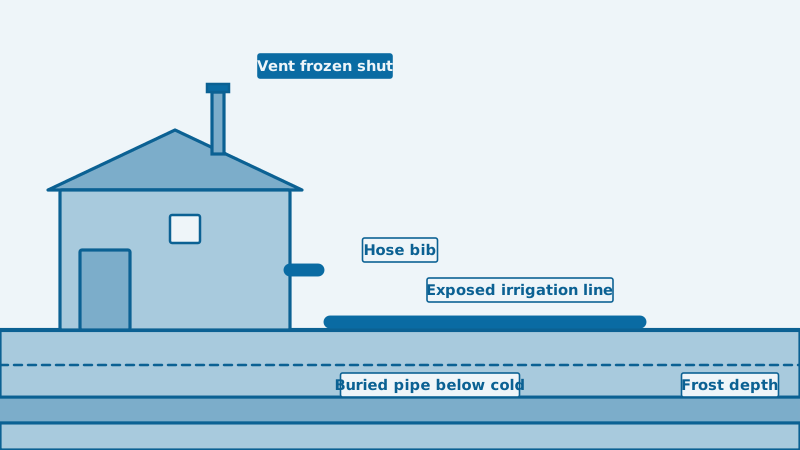
For a home owner the risk is the pipe outside the wall: hose bibs, irrigation lines and a washing-machine standpipe on an outer wall. A slow drain in a freeze is more often a vent frozen shut than a pipe full of ice. See our page on clogged drain vents for the symptoms, which include gurgling.
How much rain does Lancaster get, and why does it still flood drains?
Very little. The 1991 to 2020 normal at the Fox Airfield station is about 6.8 inches a year, according to the Los Angeles almanac's relay of federal climate normals. So rain seldom stresses a sewer here. When Lancaster sewage backs up, the cause is usually something inside the pipe: grease, wipes, a root, or a sag.
Dry weather has a side effect. Fixtures and floor drains used rarely lose their trap water to evaporation, and a dry trap lets sewer gas into the house. If a smell appears in a spare bathroom, run the water for a minute before suspecting a break. Our page on sewer smell in the house covers the rest.
How hard is the water in Lancaster?
It is on the soft side for the region. Cal Water's 2024 report for its Lancaster system lists hardness of 61 to 110 parts per million in the groundwater, averaging 86, which the company's own scale calls moderately hard. The system runs two active wells and also buys treated surface water from the Antelope Valley-East Kern Water Agency, listed at 75.
Other parts of Lancaster are served by the county's Waterworks District 40, which in its 2022 report delivered about 53 percent surface water and 47 percent groundwater. Your water bill names your supplier. Softer water leaves less scale inside old iron and steel plumbing, so it is a minor point in Lancaster's favor. Hair and grease still clog the same way.
What do drain jobs cost in Lancaster?
No Lancaster-specific survey turned up. Los Angeles area ranges are $100 to $300 for a sink, tub or toilet and $200 to $600 or more for a main line. Large lots add cable length to a job, and repairing one failed section of lateral usually runs $1,500 to $5,000. Our camera drain inspection cost page shows what the footage adds.
Request a quote on the price request page, and we'll arrange a local plumber and a written quote before work starts. Our home page lists every service.
Questions people ask
Who maintains the sewer main in Lancaster?
The city's Utility Services Division runs the Lancaster sewer collection system, according to the city's pages. Before 2008 it was maintained by the county's Consolidated Sewer Maintenance District. Treatment is by the Sanitation Districts of Los Angeles County. Ask the city who owns the lateral for your address.
Can land subsidence damage a sewer line in Lancaster?
It can in principle, since sewers depend on slope. A USGS model puts total subsidence through 2005 at about 9.4 feet at its maximum in the Lancaster subbasin, mostly north of the city. Those are model results, not measurements at your address, so a camera inspection is what shows whether your own line has a low spot.
Does it freeze enough in Lancaster to burst pipes?
Hard freezes do occur, such as the 22-degree low on November 26, 2023, reported by the National Weather Service. Exposed outdoor pipes are the risk, not buried sewer lines. Wrap or drain outdoor plumbing when a freeze warning is issued.
Is Lancaster tap water hard?
Cal Water's Lancaster groundwater averaged 86 parts per million in its 2024 report, moderately hard. County Waterworks District 40 serves other parts of the city. Check your bill for the supplier. Hardness varies by supplier and year, so the figure in your own utility's report is the one to trust.
Sources used
- Census Reporter, Lancaster city profile
- City of Lancaster, Sewer District
- City of Lancaster, Sewer Collection System
- Los Angeles County Sanitation Districts, wastewater collection systems
- Los Angeles County Public Works, Sewer
- Cal Water, Lancaster System 2024 Water Quality Report
- USGS, Groundwater-flow and land-subsidence model of Antelope Valley, California
Page updated