We arrange drain cleaning visits across Los Angeles and fifteen nearby cities, from the coast at Long Beach and Santa Monica to the Antelope Valley at Lancaster and Palmdale. The work is the same in kind everywhere: clear the blockage, look at the pipe, give you the price in writing. What changes is the house, the pipe and the rules that apply to the street outside.
This page sets out those differences, with the page for each area linked where it fits. For the services themselves, start from the home page, and for prices see the drain cleaning cost guide.
How does drain cleaning differ across Los Angeles?
It differs mostly by the age of the housing and by who runs the sewer. Cities settled before about 1960 have more clay, cast iron and fiber lateral pipe, which takes roots and cracks. Newer suburbs further out have plastic and newer clay, and clog for other reasons, such as grease and wipes. A fixed rule across the county does not exist.
The census figures in our area pages show the pattern. In Whittier, about two thirds of homes were built in 1959 or earlier. In Long Beach it is about 52 in 100, and in Palmdale fewer than 1 in 10. A home from the 1950s on a mature street, with trees planted since, is a likely place for roots in the sewer line. A home from the 1980s or 1990s in Santa Clarita or Lancaster more often needs the kitchen line jetted or a toilet line cleared.
Property type changes the job as well. In apartment-heavy places such as Santa Monica and Glendale, most drain work is in multi-unit buildings, where a clog in a shared line has to be traced to a building owner or association. In house-heavy cities such as Norwalk and Palmdale, the owner is nearly always the person who calls and pays.
Who looks after the sewer in each part of the county?
Inside every city the rule is the same: you own the private lateral from your building to the street main, and the public agency owns the main. Los Angeles County Public Works states that laterals are entirely owned by the property owner they serve. The agency that runs the main changes from place to place, and that matters when sewage is coming up in the street.
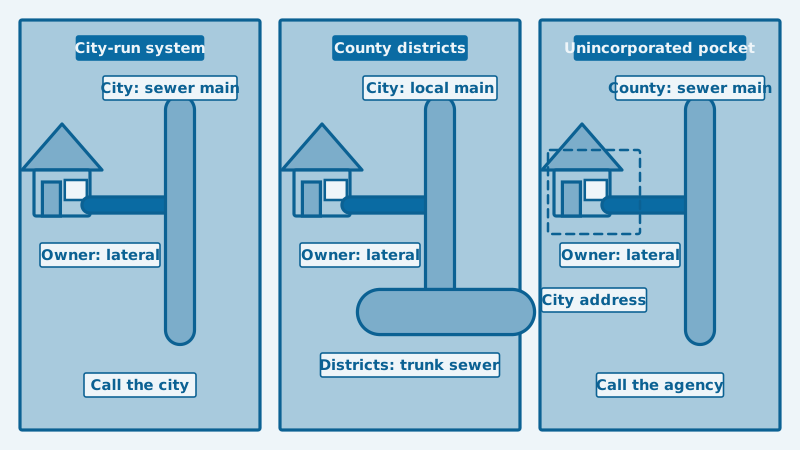
Three setups show up across our areas:
- City-run systems. Long Beach has its own sewer utility, and Long Beach Water Department says the owner maintains the lateral from the building to the sewer main. Other cities have their own arrangements, so ask your city's public works office who runs the main on your street.
- County sanitation districts. In the Santa Clarita Valley and the Antelope Valley, LA County Sanitation Districts operate the trunk sewers. Santa Clarita owns the local sewers inside its borders.
- Unincorporated pockets. Some neighborhoods with a city address are served by LA County Public Works. Its sewer maintenance staff handle backups from the public main.
If water backs up only in your own drains, the blockage is almost always in your lateral. If sewage also rises from a street manhole, call the agency, not a drain cleaner. Our guide to main line drain cleaning sets out how to tell.
What do terrain and weather change?
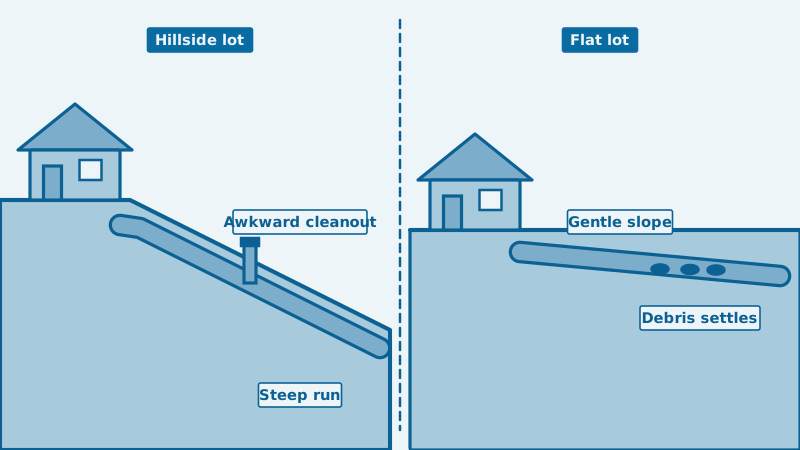
Terrain changes access, and weather can change the timing. On a hillside lot the lateral may run steeply and the cleanout may sit in an awkward place, which can add time to a visit. On flat ground the run is gentler and debris can settle. Rain is often when people first notice a slow line, because roots and loose joints show up when the ground is wet.
The high desert is a different case. Lancaster and Palmdale are mostly newer housing, so decades of root growth is less likely than in a 1950s neighborhood, and we would rather say that plainly than claim a problem that may not be there. Whatever the area, preventing a sewer backup comes down to the same things: keep fats and wipes out, know where your cleanout is, and have a camera look at a line that has clogged more than once.
Which area pages are there?
We have a page for each city, written around that city's own housing and sewer arrangements. Pick the one nearest you from the groups below, which are arranged by part of the county, and read it before you call anyone. Each page names the local sewer arrangements that matter for your address.
Coast and South Bay. Long Beach has the largest number of homes in this list, with about half built before 1960. Torrance is a tract suburb where owners often ask about long-term pipe replacement. Santa Monica is mostly apartments and condos.
Gateway cities and the southeast. Downey, Compton, Norwalk and Whittier share a 1950s housing stock with mostly owner-occupied houses. Inglewood is mostly rented, so repairs depend on landlords.
Valleys and foothills. Pasadena, Glendale and Burbank mix mid-century houses with larger apartment buildings. West Covina is mostly houses from the mid 1960s.
North County and the high desert. Santa Clarita, Lancaster and Palmdale have the newest homes, mostly from the 1980s and 1990s.
If you live somewhere else in the Los Angeles area, send a request anyway, and we'll tell you whether we can arrange a visit.
What do prices look like across Los Angeles?
Prices in the county move less by city than by job type. Most published Los Angeles price lists give one range for the region, not a table by city, so we use these as the guide for every area. Access, pipe age and timing move a quote more than the city does. matter more to the final quote than the city name does.
| Job | Typical range |
|---|---|
| Sink, tub or shower drain | $100 to $300 |
| Drain snaking, one fixture or branch | $100 to $500 |
| Sewer drain cleaning | $200 to $900 |
| Main sewer line clog | $200 to $1,000 |
| Hydro jetting | $350 to $900, heavy jobs up to $1,100 |
| Camera inspection | $150 to $400 |
| Spot repair of a sewer line | $1,500 to $5,000 |
| Sewer line replacement | $5,000 to $15,000 |
These figures come from published prices of drain cleaning businesses and cost guides for Los Angeles, checked in November 2026. They are a guide, not a quote. The real price comes from the drain cleaner who visits, in writing, before any work starts.
Distance can add something in the outer areas: a visit to Palmdale from the central county takes longer than one to Burbank, and some businesses add a travel charge. Ask about it when you book. Emergency and evening calls add a surcharge everywhere. For the detail on each job, see sewer drain cleaning cost, hydrojet cost and sewer line replacement cost.
How do you book a visit in your area?
Send a request with your city, the fixtures affected and what you have already tried. We'll arrange a local drain cleaner who covers your area to contact you and book a visit. You get a written quote before anything starts, and nothing goes ahead until you say yes.
The price request form is the quickest route. If you would rather ask a question first, the contact page shows the email and hours, which are Monday to Friday, 9am to 5pm. To learn what the service is, read about LA Drain Works, and for the problems we get asked about most, the guides section is organized by topic.
Questions people ask
Do prices change between areas of Los Angeles?
Not much for standard jobs. A drain cleaned in Burbank and one in Downey usually fall in the same range. Prices move more with the job, such as a main line versus a sink, and with access and the hour of the call. Outer areas such as Palmdale may add a travel charge, so ask before you book.
Do you cover areas that are not listed?
Fifteen cities have their own pages, but the list is not a hard border. Send a request with your city and we'll say whether a local drain cleaner can reach you. Neighborhoods inside Los Angeles itself, such as the valley and the westside, are covered through the same request form.
Who do I call if sewage is coming up in the street?
Call the agency that runs the public sewer, not a drain cleaner. In unincorporated areas that is LA County Public Works, and in most cities it is the city's own sewer department. If the backup is only in your fixtures, the cause is probably your lateral, and a drain cleaner can help.
Is the sewer lateral my responsibility everywhere in the county?
Generally yes. Los Angeles County Public Works says laterals are owned by the property owner they serve, including the part under the street. Long Beach says the same about its laterals, and shares the section under the street. Check with your city's sewer department if you need a ruling on your exact address.
Guides in this section
- Burbank
Burbank drain cleaning: the city's SLURP rebates for cleaning and replacing a sewer lateral, why it bans lining in the street, plus roots,…
- Compton
Compton drain cleaning: older 1950s homes on big lots, a city sewer system with a documented overflow history, and how to tell a main…
- Downey
Drain cleaning in Downey: who owns which pipe, the two city permits for lateral work, hard well water, 1950s homes and what jobs cost.
- Glendale
Glendale drain cleaning: the pipe from your house to the main is generally yours.
- Inglewood
Inglewood drain cleaning: pre-1960 clay mains, county trunk sewers, the city's lateral rule, root control chemicals and what renters and…
- Lancaster
Lancaster drain cleaning: the city-run sewer district, a valley that is sinking in places, hard freezes, soft-to-moderate water and…
- Long Beach
Long Beach drain cleaning: who owns each half of your lateral, the gas cross bore check before any root cutter, cleanout rules and how to…
- Norwalk
Norwalk drain cleaning: the city's lateral rules, when it recommends a camera, 1950s clay pipe, street tree limits and how to book a visit.
- Palmdale
Palmdale drain cleaning: a mostly post-1980 sewer, the city's lateral rule, three water sources, desert freezes, septic tanks and typical…
- Pasadena
Pasadena drain cleaning: 90-year-old clay mains, the city's permit rules for sewer repairs and lining, hard water, protected trees and how…
- Santa Clarita
Santa Clarita drain cleaning: how the city, county and sanitation district split the sewer, oak tree limits, hills and clay, and typical…
- Santa Monica
Santa Monica drain cleaning for apartments and condos: clay mains, ficus roots, the city sewer permit and its fees, and softened water.
- Torrance
Torrance drain cleaning for 1960s tract homes: the city's lateral policy, two permits, street tree roots and who pays when a city tree is…
- West Covina
West Covina drain cleaning: a 1950s boom town with 1960s houses, the city's 15-foot tree rule, permits, city help for tree damage and…
- Whittier
Whittier drain cleaning: the oldest housing stock of our areas, the city's video-before-permit rule, city versus county addresses, well…
Sources used
- Los Angeles County Public Works, Sewer: owner responsibility for the lateral
- LA County Sanitation Districts, Wastewater collection systems
- Long Beach Water Department, Sewer
- US Census Bureau data for each city, via Census Reporter
- Published prices of drain cleaning businesses and cost guides covering Los Angeles, checked November 2026
Page updated