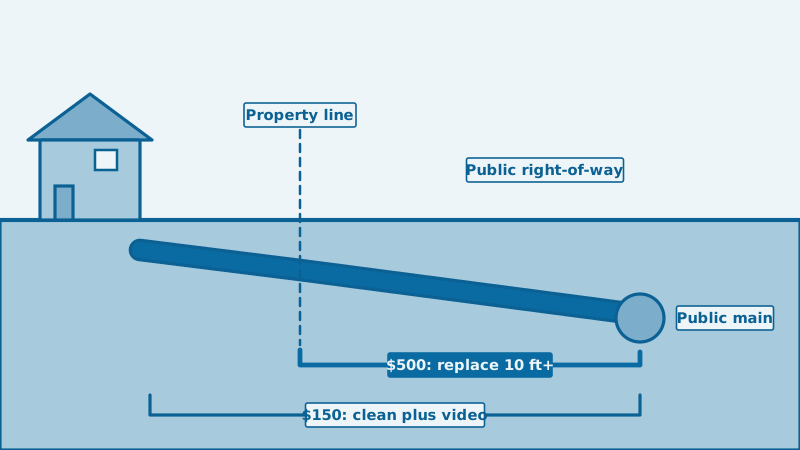
Burbank runs a rebate program called SLURP, short for Sewer Lateral User Rebate Program, and it is the first thing worth knowing before you hire anyone for a sewer problem here. The city pays $150 toward a cleaning that is followed by a video, and $500 toward replacing a lateral, if you follow its steps.
Below is how those rebates work, what the city bans, and how the rest of the Los Angeles areas we cover differ from Burbank. The dollar amounts come from the city's FAQ page, which dates the replacement rebate to 2008, so confirm today's figures with Public Works at (818) 238-3915.
How does Burbank's sewer lateral rebate work?
For cleaning, you pay a plumber to clean your lateral and then record a video of the cleaned pipe. Bring the recording, which must show your address, to the city and you qualify for a $150 rebate, paid as a credit on the sewer bill. The video must run all the way to the public main, so ask for that in the quote.
The video includes the 6 inch pipe from the property line to the main. The program covers single-family homes and duplexes, with duplexes only when the renters pay the sewer charge. Houses connected through a rear easement qualify too.
For replacement, the city offers $500 when at least 10 feet of the lateral in the public right-of-way is replaced. Only one replacement rebate is paid per owner for as long as that owner holds the property. The sewer contractor has to pull an excavation permit and a sewer connection permit before starting.
You can do the cleaning yourself and still claim, but the city recommends a plumber because of the safety risks.
Why does Burbank not allow sewer pipe lining in the street?
The city's FAQ says lining is not permitted in the City right-of-way. Pipe bursting, on the other hand, is accepted: two pits are dug, a bursting head is pulled through the old lateral, and a new seamless plastic pipe follows behind it.
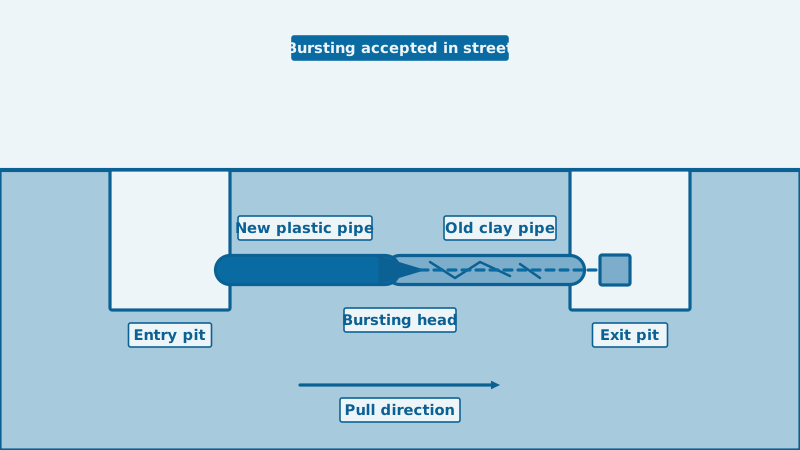
So in Burbank the debate in pipe lining versus replacement is settled for the street section. The FAQ speaks only about the right-of-way, so ask Public Works what applies on your own lot. Our explainer on trenchless pipe replacement shows how bursting compares.
What does the city maintain, and what is left to owners?
The city runs about 230 miles of sewer pipe, roughly 3,800 maintenance holes and two pumping plants. Its 2025 management plan counts about 25,500 privately owned laterals and states that every one of them belongs to the owner, as Burbank Municipal Code 8-1-107 says.
Burbank sends wastewater to its own Water Reclamation Plant. Because the owner holds the lateral, a root problem in it is the owner's to fix. A hydro jetting visit is the method the city's FAQ calls typically best for laterals, since jetting generally cleans better than mechanical cutters, at a higher price.
What if the roots came from a parkway tree?
The lateral is still yours to keep working, even if the roots belong to a tree the city planted. The city's FAQ points out that roots rarely hurt a lateral unless there is an open joint or a crack. The exception is a lateral that a city tree in the city parkway has crushed or knocked out of line: the city reimburses that repair, up to limits the city sets.
The reimbursement applies only if the city inspects the damage before the broken pipe is removed.
If you suspect that, call Public Works before the dig starts. A sewer camera inspection recorded beforehand gives both sides the same picture.
What do Burbank's houses and hillsides mean for drains?
The typical Burbank home was built in 1959, and just over half of its 46,243 homes were built that year or earlier. The city grew fast with the aircraft plants and studios, and tracts in Magnolia Park went up between 1945 and 1950, so a great many laterals date from the postwar boom. Median home value is about $1.09 million.
The Verdugo Mountains form the city's northern edge, so lots near the hills can have steeper laterals than the flat part of town. A steeper run drains faster but can carry grease and solids past a weak point, so a camera is the way to know.
How hard is Burbank water, and what does a cleaning cost?
Burbank's water is very hard, roughly 285 parts per million in Burbank Water and Power's recent reports. Part of the supply is local groundwater treated at the Burbank Operable Unit plant. Hard water is one more reason to look at the pipe on camera, and the next paragraph covers what that job costs.
The city's own guide for the cleaning-plus-video job gives a typical $300 to $700, depending on the pipe and the plumber's equipment. A cleanout adds to that if the house has none. Treat the city's figure as a guide, not a quote. For current Los Angeles ranges, see sewer lateral cleaning and our cleanout cleaning page.
Questions people ask
Do I need a permit to clean or camera my Burbank sewer lateral?
The city says cleaning and video inspection need no permit. Replacing pipe on your property needs a plumbing permit, and replacing pipe outside your property needs a sewer connection permit and an excavation permit, so a repair is a different matter.
How often should a Burbank sewer lateral be cleaned?
The city says it depends on the nearest tree, the tree type, the depth of the line and how well the lateral was built. It can be as often as twice a year or as rarely as once in ten years. A video after the first cleaning shows where you fall.
Does Burbank replace sewer laterals for homeowners?
No. The city does not have the staff to clean private laterals and does not replace them. It pays rebates after the work is done, and reimburses the crushed section when a city parkway tree is the proven cause. If you think a parkway tree is the cause, call Public Works before the dig starts.
Is a cleanout required in Burbank?
The city says not every property has one and it is not required, but it recommends one. A cleanout lets a plumber reach the line without pulling a toilet, which is why we ask where yours is when you request a price on the price request page. The LA Drain Works home page lists the other services.
Sources used
Page updated