According to Wikipedia, West Covina was incorporated in 1923, reportedly to stop neighboring Covina from putting a sewage farm in the area, and then it filled with houses almost all at once. Between 1950 and 1960 its population grew from under 5,000 to more than 50,000. If you live in one of those homes, the drain line under your lawn is from that boom.
This page is about that line, the city rules around it and the ground it sits in. It is one of the areas of Los Angeles we cover, and most of West Covina is a generation or two younger than the oldest parts of the county.
What kind of sewer pipe is under a West Covina house?
Most of West Covina's 36,078 homes were built around the mid-1960s, and fewer than half date from before 1960. About 6 in 10 are houses. Pipe from that period varies by builder and lot, and the honest answer is that a camera is the only way to know.
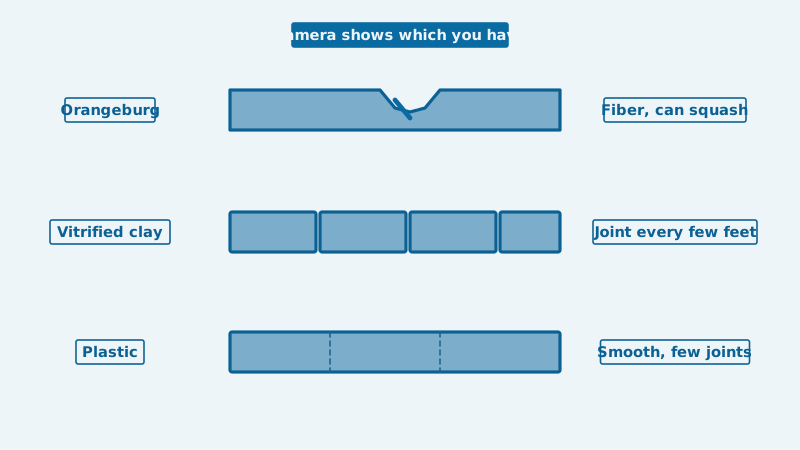
Postwar tracts across the country sometimes used Orangeburg, a tar-impregnated fiber pipe that, according to Wikipedia, was weak and brittle and in some cases failed within 10 years. Clay and cast iron were also in use. Cast iron corrodes inside, forming tubercles that narrow the pipe, while Orangeburg is the weaker of the two. A camera drain inspection price tells you what that look costs before you commit to a cleaning that may not be enough.
How does West Covina treat tree roots near the sewer?
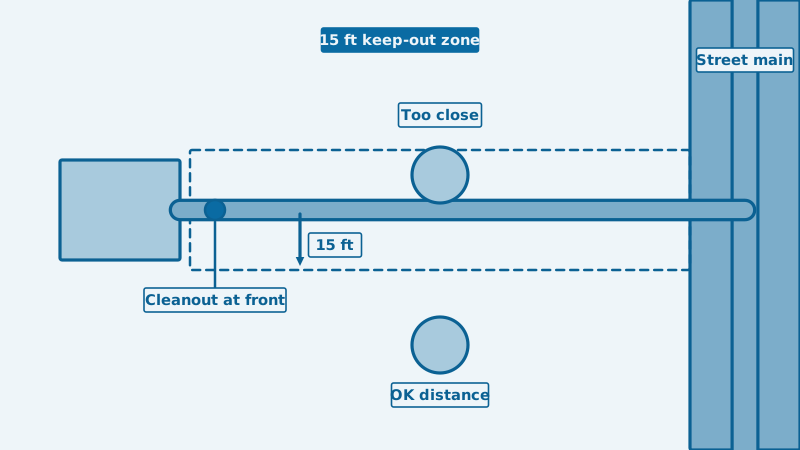
It gives homeowners a distance to follow. The city's own advice is not to plant trees or any deep-rooted vegetation within 15 feet of the sewer line, and to put in a cleanout at the front of the house if you do not have one. It also warns that grease-dissolving additives can just push grease down the pipe to clog somewhere else.
Roots in sewer pipes, the city says, may be the most expensive sewer maintenance problem a homeowner meets. The city may help after it verifies that a city-authorized and city-owned tree damaged the line between the main in the street and your lateral pipe. Call the Public Works Maintenance Division, 626-939-8458, to report it. The division is open Monday to Thursday, 8 a.m. to 4 p.m., and closed on Fridays.
For the pipe side of the problem, removing roots from a sewer line compares what works and what does not.
Who runs the sewer, and where does it end up?
The city's Street and Sewer Maintenance division looks after the local sewers. Those connect to trunk sewers operated by the Sanitation Districts of Los Angeles County, which carry the flow on to regional treatment. Which of the two handles a problem depends on where it is, so start by finding out whether the blockage is in your own line.
Which trunk line serves your street is a question for Public Works, so check your own address if it matters. What does not change from one address to the next is that a house blockage is almost always yours, and that sewage rising from a manhole belongs to the city.
Which permits come into play for a West Covina sewer job?
The city's sewer code sits in Chapter 23, Article II, Division 7. It allows the owner of a lot used only for residence to be issued a permit to build their own domestic house connection sewer. Anyone other than the owner must apply in writing and bring a signed statement, dated within 15 days, from the owner or the owner's agent. If the work is in a state highway, Caltrans has to issue a permit as well.
For plumbing inside the lot, the Building Division says installing or relocating plumbing lines, sewer included, needs a building permit, so call the Building Division before you start. Pure cleaning is not a repair, but if a camera finds a break, expect the repair path to start there.
Which water utility serves a West Covina address?
It depends on the street. Suburban Water Systems covers much of the city, and the city's utilities directory also lists Valley County Water District and San Gabriel Valley Water Company, among others. Your bill names yours. Because the supplier changes by street, any hardness figure applies only to the area that utility serves.
Suburban's 2025 San Jose Hills report shows why a single number is unreliable. Treated surface water averaged 9.5 grains per gallon with a range of 5 to 16.4, while its groundwater averaged 12.7, ranging from 9.9 to 17.8. Both sit in the hard to very hard bands, and the blend shifts through the year.
What about winter storms and flooding?
Heavy rain can send water into loose joints and overload lines, and a storm is when a weak lateral often shows itself. Sandbags are for water crossing the surface, not for sewage rising through a drain. If a backup happens in a storm, our sewer backup prevention page covers what stops it returning.
Questions people ask
How much does drain cleaning cost in West Covina?
Los Angeles area ranges run about $100 to $300 for a sink or tub and about $200 to $600 for a main line. West Covina has no separate city price list, so see our drain cleaning cost page, then use the price request form for a written quote. The home page lists every other service.
Will West Covina pay if a city tree broke my sewer?
It may help, but only after it verifies that a city-authorized, city-owned tree damaged the section between the street main and your lateral. Call 626-939-8458 before the pipe is repaired, so the city can look at the tree and the damage.
Should I install a cleanout on my West Covina house?
The city recommends one at the front of the house if you do not have one. It gives a plumber a way into the line without removing a toilet, and it is where a camera starts. If you are already having the line cleared or inspected, that is a sensible time to ask about adding one.
What should I not pour down the drain in West Covina?
The city says to put grease and food scraps in the trash, use baskets in sink drains and be wary of chemicals that claim to dissolve grease, since some only move it down the pipe. A hair catch in the shower helps too.
Sources used
- City of West Covina Public Works, Maintenance, Tree Related Sewer Problems
- West Covina Municipal Code, Chapter 23, Article II, Division 7, Permits
- City of West Covina, Utilities directory
- Suburban Water Systems, San Jose Hills System Water Quality Report, 2025
- Wikipedia, West Covina, California
- Wikipedia, Orangeburg pipe
- US Census Bureau data for West Covina via Census Reporter
Page updated