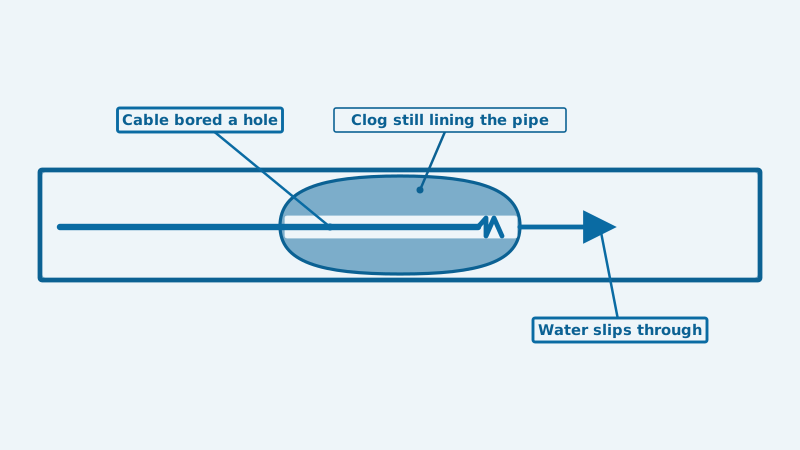
You ran a drain snake, felt it go in, heard the water gurgle, and then the sink or tub went back to standing water. That is frustrating, and it is common. A snake is a narrow tool. It can bore through a soft clog and miss the real problem, turn the wrong way at a junction, or stop at something it cannot cut. Knowing why it failed tells you what to do next, and it is often not a bigger snake. The basics of the tool are in our drain snaking guide.
Why would a drain still be clogged after I snaked it?
Most often the snake made a hole through the clog without removing it, so water runs through for a few days and then the blockage closes again. Other reasons are that the tool went down the wrong branch, never reached the clog, or hit a blockage it cannot cut, like roots or a collapsed pipe.
Here are the usual explanations, in rough order of how often plumbers see them:
- A pilot hole. The drain snake punched a channel through hair or grease. Water flows, then the pipe re-clogs.
- Too short a cable. A hand-crank drain snake of 15 to 25 feet may not reach a clog in a branch line or a main drain.
- The wrong path. At a junction the cable can go down a different branch than the one that is blocked.
- A blockage the head cannot grab. Grease coating on the wall, scale or a wad of wipes may just slide off the tip.
- Roots or a broken pipe. The cable hits a wall and stops, or gets caught.
- A vent or main line issue. The clog is not in the pipe you snaked at all.
Is the clog actually still there?
Sometimes the pipe is clear but the drain behaves as if it were not. A partly blocked vent can make a clean drain run slowly and gurgle, and a blockage further downstream, in a shared branch or the main line, can back water up into the fixture you cleared.
Check these signs before you snake again:
- Other fixtures are slow or gurgle when you use water.
- A toilet bubbles when the tub drains.
- A sewer smell appears with the slow drain.
- The blockage returns within days.
If any of those fit, the problem is likely past the first section of pipe, in the shared line. Our pages on gurgling drains and main line drain cleaning explain what to look for next.
How do I know whether the snake was the wrong tool?
Ask what the blockage is made of. A drain snake or auger is best at breaking up or pulling out hair, paper and soft material near the fixture. It is poor at removing grease that has coated the pipe wall, scale that has narrowed it, or a root mass in a main line. Those need a cutter or a hydro jet.
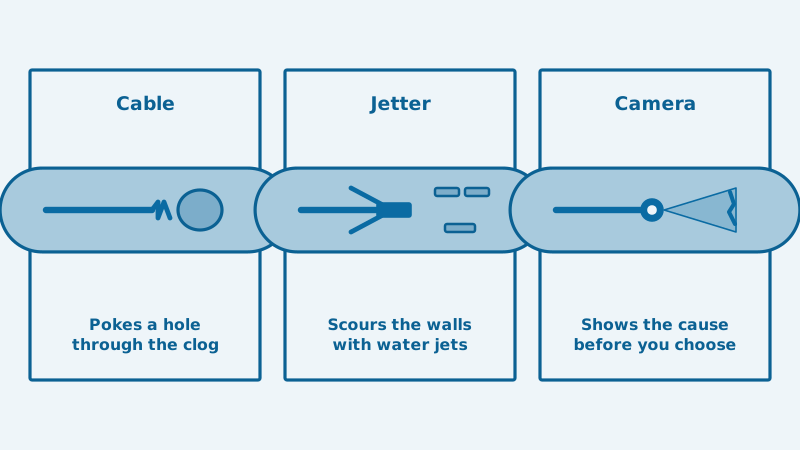
The tool matters. A hand-crank "drum" auger suits sinks and tubs. A power cable machine with cutting heads suits larger lines and roots. A hydro jet uses high-pressure water to scour the wall. None of them can fix a collapsed pipe, because there is nothing to clear.
| Likely blockage | Better tool |
|---|---|
| Hair at a tub or shower drain | Barbed tool or small hand auger |
| Soft clog in a sink | Hand auger, trap cleaning |
| Grease coating the pipe | Hydro jet |
| Roots in a line | Cutting head on a power cable, then jet |
| Collapsed or broken pipe | Repair, after a camera |
Our guide to hydro jetting versus snaking explains when to move from one to the other.
Can snaking a drain cause a leak?
It can, though it is uncommon. A snake does not usually harm a sound pipe, but forcing a cable through old, brittle or corroded pipe, or around a tight bend, can crack a weak spot or loosen a fitting that was already marginal. More often the leak was already there and the snake exposed it.
If you notice a drip under the sink, a wet cabinet or damp soil after snaking, stop and look. A dry paper towel held under each joint shows drips well. Slip nuts on a trap can be re-tightened by hand. If you see water at a pipe wall or a joint inside a wall, do not keep snaking, and call a plumber. Clay and cast iron pipe, common in older Los Angeles houses, are the most fragile.
Why does the clog keep coming back after snaking?
Because the cause is still there. Hair that keeps entering, grease that keeps coating, roots that keep growing, or a pipe with a sag that holds water will all rebuild the blockage. A snake clears the symptom, not the source.
Plumbers often say roots regrow within weeks or months after a cable cut, because the entry point in the pipe is still open. A camera shows what is feeding the clog. If the answer is roots, ask about tree roots in the sewer line and the options to stop them, such as cutting, jetting, lining or replacement. In Los Angeles, the owner is responsible for the private lateral, including the part under the street, so a recurring clog in that stretch is yours to fix.
What should I try next?
Check the basics again: the stopper, the trap and the vent. Then use the right tool for the material. If water still stands, or other drains misbehave, stop and have a camera look at the line. Repeated snaking of the same clog wastes time and can damage old pipe.
A short plan:
- Clean the trap by hand and the first section of pipe.
- Use a plunger with a good seal for sinks and tubs.
- If it works for a day and returns, the clog is a pilot hole; a jet or a cutting head is next.
- If other fixtures are slow or gurgling, treat it as a branch or main line problem.
- Avoid chemical cleaners on top of a failed snaking, since they leave caustic water in the pipe for the next person.
When should I call a drain cleaner?
Call when a second attempt fails, when more than one drain is affected, or when the clog returns within days. A drain cleaner has longer cables, cutting heads and a hydro jet, and a camera that shows what is wrong, so you stop guessing.
We'll arrange a visit where the plumber confirms the cause, clears it with the right tool, and tells you if the pipe needs repair. See plumber snaking drain for what that visit usually involves.
If your drain is still clogged after snaking, request a price and we'll arrange a visit. You can also see the LA Drain Works home page.
Questions people ask
How long does it take to clear a drain that snaking did not fix?
With the right tool, a stubborn clog usually clears in an hour or two once the plumber reaches it. If a camera look is needed first, add some time. If the pipe is damaged, repair takes longer and gets its own quote and schedule.
What should I ask before I hire someone after a failed snaking?
Tell them what you tried and how far your snake went before it stopped. Ask what tool they will use, whether a camera is included, and what happens if the clog returns. Get a written quote before work starts, and ask to see what comes out of the pipe.
Do I need to be home for the visit?
Yes, at least at the start, so the plumber can see the fixture, reach the cleanout and hear what you noticed. Clear the space under the sink or around the tub, and mention which tool you already used. Say if the clog returned after snaking.
Should I snake it again myself?
One more careful try with a longer cable or a different tool is fine. If the cable stops at the same spot, or the clog returns within days, stop. Repeated snaking can scrape or crack old pipe and does not fix a pipe that is damaged.
Is a rooter machine the same as a drain snake?
A "rooter" is a power cable machine, often with cutting heads for roots. It is a bigger version of the same idea, and it reaches further. It still leaves buildup on the pipe wall, which is why plumbers often follow it with a jet.
Sources used
- LA County Public Works, sewer lateral customer information
- Published guides from Southern California drain cleaning businesses, checked November 2026
Page updated