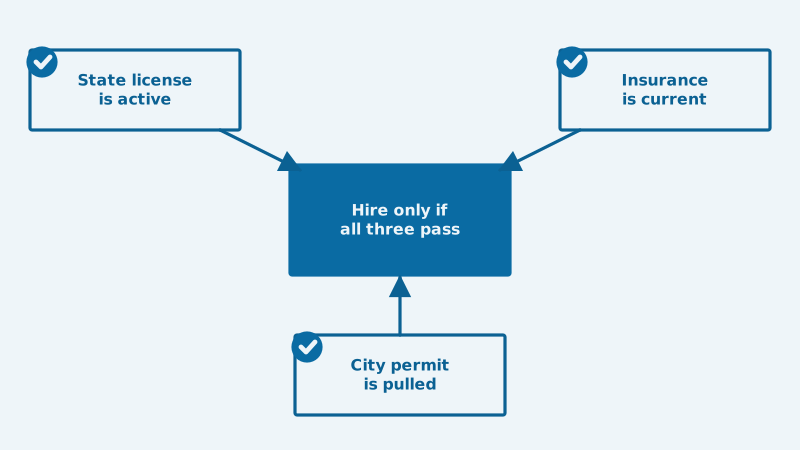
A sewer line replacement contractor should hold a California contractor license in a class the state allows for building sewers, pull the permits, and give you a written price after a camera inspection. Check the license number on the state contractors board website, ask what method is proposed and why, and never pay more than the legal deposit up front. Our page on trenchless sewer repair explains the methods you will hear about.
Who is allowed to replace a sewer line in California?
The state contractors board says general engineering (A), pipeline (C-34), plumbing (C-36) and sanitation system (C-42) contractors may install or repair building sewers. A general building contractor (class B) may do it only where the work falls within what that class covers. A handyman without a license should not.
The classes differ in what else they do. A plumbing contractor is the usual choice for a house lateral. A sanitation system contractor does sewer and drain work. A general engineering contractor typically handles larger underground work. The one that matters for you is that the class matches the job.
Two things to know about permits in Los Angeles. Work entirely on private property generally needs a city plumbing permit. Work in the public right of way, such as the part of the lateral under the street, needs an S-Permit from the Bureau of Engineering, issued to an active Bonded Sewer Contractor. A contractor who says no permit is needed deserves a harder look.
How do I check a sewer line replacement company?
Look up the license number on the state contractors board website. Confirm that the license is active, that the classification fits sewer work, and that the bond and workers' compensation status are in order. Then ask for the permit numbers once they are pulled. Do all of this before you sign.
A short checklist:
- License. Active, in a class allowed for building sewers.
- Name match. The name on the license matches the name on the contract and the truck.
- Permits. The contractor will pull them, and says so in writing.
- Camera. They look at the line first, and show you the footage.
- Written scope. The quote says the length, depth, pipe material and method.
- Surface repair. The quote says who restores the lawn, paving or concrete, and to what standard.
If any of these is vague, ask for the answer in writing. A good contractor will not mind.
Which sewer line replacement method will a contractor propose?
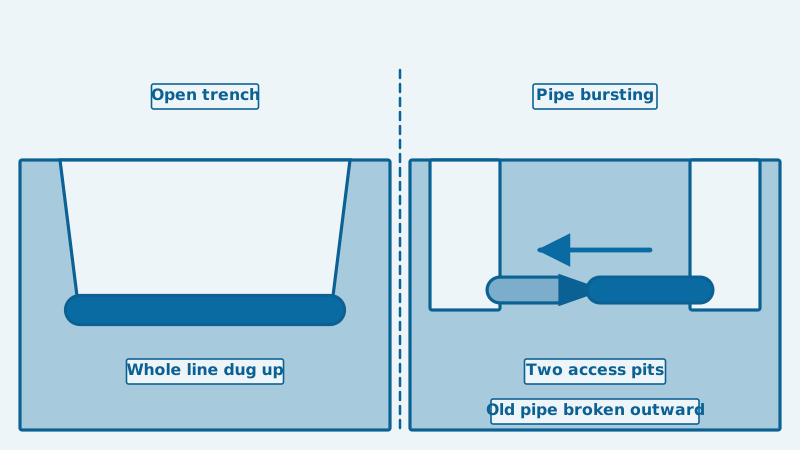
Usually one of three: open trench, pipe bursting, or lining. Open trench digs along the line, removes the old pipe and lays new. Bursting breaks the old pipe from inside and pulls new pipe in behind, using only pits at each end. Lining seals a sound pipe from inside. The camera decides.
| Method | When it fits | Digging |
|---|---|---|
| Open trench | Collapsed or badly offset pipe, short shallow runs, a change of route | The whole run |
| Pipe bursting | Pipe that is fully failed but in a straight line | Two pits |
| Lining | Pipe still round and open, with cracks or joint trouble | Little or none |
A contractor who offers only one method is selling what they have, not necessarily what you need. Ask what the camera shows, why this method fits, and what the price would be for the others. Our guides to trenchless pipe replacement, pipe lining versus replacement and sewer line replacement cost set out the choices.
How should I compare quotes from sewer line replacement contractors?
Ask each for the same written scope, then compare what is in and out. Get at least two quotes, after each contractor has seen the camera footage. A much lower price than the rest usually leaves something out, such as the camera, permits, or surface repair.
Compare these lines side by side:
- Length and depth covered, and the pipe being installed
- Method and the reason for it
- Cleaning, root removal and any pre-repair
- Camera before and after
- Permits and inspections, and who pays the fees
- Surface restoration
- Payment schedule
- Warranty on the work, in writing
Our page on why sewer line replacement is so expensive helps you see why one quote can run double another.
How much can a contractor ask for up front?
For a home improvement contract in California, the contractors board says the down payment is capped at the lesser of $1,000 or 10 percent of the contract price. Beyond that, payments should follow the work. A contractor who asks for half the price before starting is asking for more than the law allows.
Keep a copy of the signed contract, the permit and the final inspection. Pay the balance after the work passes inspection and the site is restored. Ask the contractor for lien releases if they use subcontractors or buy material on account.
What happens on a sewer line replacement job?
The contractor cameras the line, pulls permits, then digs or sets up the trenchless pits. The old pipe is removed or burst, the new pipe is laid at a steady fall, and the line is tested and inspected. Then the pit or trench is backfilled and the surface repaired.
Time varies with length, depth and method. Lining and bursting can be done in a day or two for a typical lateral, and open trench takes longer, particularly if concrete or landscaping must be put back. Your water will be off for part of the work, so ask when.
Before you start, the owner is responsible for the entire lateral, including the part under the street, according to Los Angeles County Public Works. That means the contract is with you, even for the part in the street.
If you are unsure whether you need replacement or a smaller fix, our sewer line repair page covers spot repairs, and how to repair a broken sewer line covers the signs.
Where do I start?
Start with a camera inspection of the line, then ask two or three contractors to quote from the footage. You can send a quote request, and we'll arrange a visit from a local drain cleaner who looks at the line and gives a written price. Nothing is done until you agree. The LA Drain Works home page lists what else we arrange.
Questions people ask
What kind of contractor replaces a sewer line?
In California, plumbing (C-36), sanitation system (C-42), pipeline (C-34) and general engineering (A) contractors may install or repair building sewers, according to the state contractors board. For a house lateral, a plumbing contractor is the usual choice. Check any license on the board's website before you sign.
Is a plumber the right person for main line sewer replacement?
Often, yes, if the plumbing business holds the right license and does sewer work. Main line replacement is dig and pipe work as well as plumbing, so ask how many laterals they have replaced, whether they use their own crew and who pulls the permits. A plumber who only does repairs may refer the job out.
Do I need a permit to replace a sewer line in Los Angeles?
Yes in most cases. Private-side plumbing work generally needs a plumbing permit, and work in the street or sidewalk needs a separate S-Permit that goes to a Bonded Sewer Contractor. Fees and rules change, so ask the contractor to confirm the current requirements with the city.
How long does it take to replace a sewer line?
A typical house lateral can take a day or two for lining or bursting and several days for open trench, plus permit and inspection time. Long runs, deep digs, hillsides and concrete take longer. Ask for a schedule in writing, including when water is off.
Can I choose trenchless for my sewer line replacement?
Only if the pipe suits it. Bursting needs a pipe that is fully failed but in a reasonably straight line, and lining needs a pipe that is still open. A collapsed or badly displaced pipe may need an open trench. The camera footage tells you which options are real.
Sources used
- CSLB, Building Official Information Guide, who may install or repair building sewers
- CSLB, C-36 Plumbing Contractor classification
- CSLB, C-42 Sanitation System Contractor classification
- Los Angeles County Public Works, Sewer: owner responsibility for the lateral
- City of Los Angeles Bureau of Engineering, permit manual, sewer S-permits
- Pipe bursting, overview
Page updated