Call a plumber for a main line clog the moment two or more fixtures are slow, a toilet gurgles when the shower drains, or the lowest tub or floor drain starts to fill. A plumber brings a motorized cable and often a jet and camera, and clears the line in one visit. Our guide to main line drain cleaning explains the symptoms; here is how to hire well.
What kind of plumber should I call for a main line clog?
Call a plumbing or drain business that clears main sewer lines with a powered cable, ideally with a hydro jet and a camera on the truck. A handyman or a small-fixture plumber may not carry the machine a long root-filled run needs. Ask directly if the business handles main lines and what it brings.
On the legal side, California requires a contractor with the right CSLB classification for work of $1,000 or more in labor and materials. CSLB lists A (general engineering), C-34 (pipeline), C-36 (plumbing) and C-42 (sanitation system) contractors for building sewer work, and LA Sanitation refers to a plumbing contractor (C-36) for work entirely on your property. A simple clearing job often falls below $1,000, but a repair that follows will not. Check any contractor's classification on the CSLB site before you agree to a repair.
What happens when a plumber snakes the main drain?
The plumber runs a motorized cable down the line from the cleanout, a roof vent or a pulled toilet. A cutting head on the end tears through roots, grease or paper until the line opens. Water is run to test flow, and a camera usually follows to show what caused the clog. Most visits take a couple of hours.
Snaking the main drain pipe is a skill job in three ways:
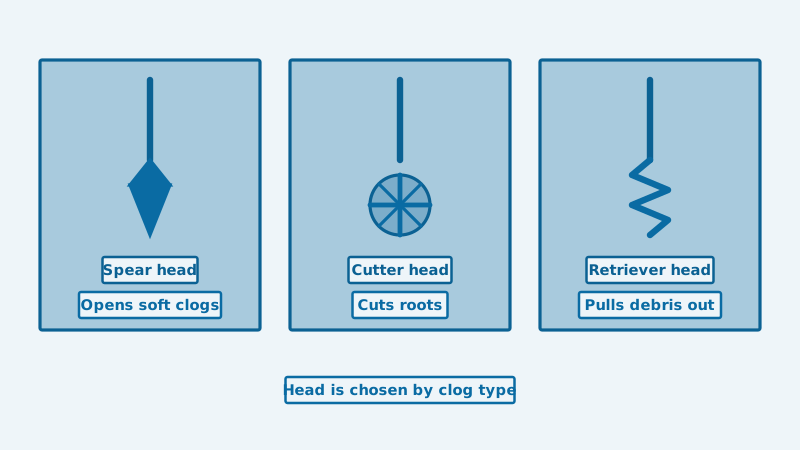
- Choosing the head. A spear opens soft clogs, a blade or saw chain cuts roots, and a toothed head scrapes pipe walls.
- Feeling the line. A good operator senses the difference between a root mass, a sag, a joint and a break by the way the cable turns.
- Knowing when to stop. Forcing a cable against a collapsed joint can damage the pipe, and a plumber should say so and call for a camera instead.
A cable opens a hole through a blockage but leaves the pipe wall coated. If the line is full of grease or scale, a jet should follow. Our page on hydro jetting versus snaking shows when each is worth it.
How do I know the clog is in the main line and not a single drain?
If only one sink or tub is slow, the clog is in that fixture's branch. If several fixtures slow at once, if a toilet bubbles when another drain runs, or if the lowest drain in the house backs up first, the clog is probably in the main line. A quick test is to run a sink and watch the lowest tub for gurgling.
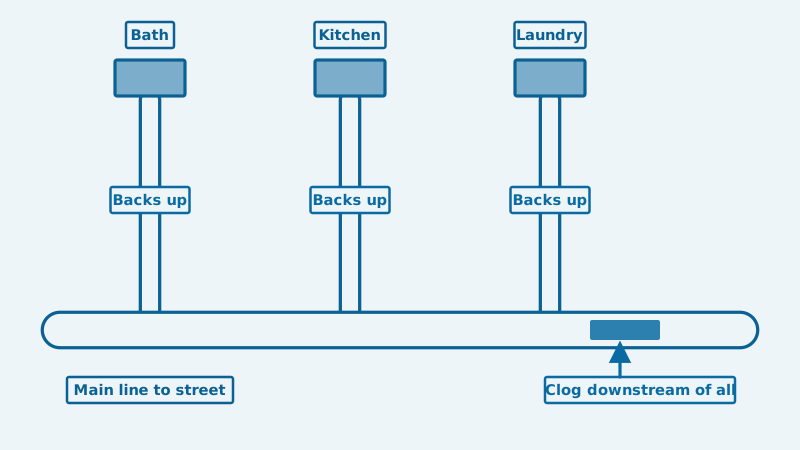
A few checks before you call can save time:
- Flush a toilet. Does water rise in a tub or floor drain?
- Run a bathroom sink for a minute. Does the toilet gurgle?
- Look at the cleanout cap outside, if you have one, for standing water. Do not open it if the line is full.
- Ask neighbors. If the street's sewer is the problem, LA Sanitation runs a 24-hour customer care line at 1-800-773-2489.
If your whole street is affected, the city main may be the cause. If only your property is, the pipe from the house to the city connection belongs to you, including the part under the street. LA Sanitation lists this plainly as owner responsibility.
How much does a plumber charge to clear a main line?
Published Los Angeles prices put cable clearing of a main line at about $150 to $600 and hydro jetting at $300 to $1,000, with the lower end for an outdoor cleanout and the higher end when the plumber pulls a toilet or climbs to the roof. Emergency hours add $50 to $300. A camera pass is often $100 to $350 extra.
| Job | Typical price |
|---|---|
| Cable through an outdoor cleanout | $150 to $500 |
| Cable through a vent or pulled toilet | $250 to $600 |
| Hydro jet on the main | $300 to $1,000 |
| Camera pass | $100 to $350 |
| Evening or weekend call | add $50 to $300 |
These are guides from published figures, not quotes. Our main sewer line clog cost page has the full breakdown, including cleanup after a backup.
What should I ask before I hire a plumber for a main line clog?
Ask five things: the total price including a camera pass, which tool they will use, whether the price rises if they have to pull a toilet, what CSLB classification they hold, and whether you get the video or notes. Get the quote in writing before work starts. A business that hesitates on any of these is worth skipping.
Be wary of three patterns. A phone price far below the published ranges often grows on arrival. A recommendation to replace the whole line before a camera has looked at it is premature. And pressure to sign on the spot, with sewage not yet in the house, is unnecessary.
If you want us to arrange a visit, request a written price and describe what the drains are doing. Our home page shows the other drain jobs we arrange.
Questions people ask
Can a main line clog wait until morning?
If sewage is only slow to drain and nothing has overflowed, you can usually wait a few hours, but stop running water. If sewage is coming up in a tub or floor drain, do not wait. Rising sewage damages floors and walls fast, and an after-hours fee is often smaller than the cleanup.
Will the plumber clear the clog or find the cause?
A cable visit clears the clog. Finding the cause takes a camera pass, which many plumbers offer as an add-on and some include. Without it, you may pay for the same visit again in a few months if roots, a crack or a sag is the cause.
How long does it take a plumber to clear a main line?
A straightforward clog through an accessible cleanout often takes one to two hours. Roots, a long line or a missing cleanout can stretch it to half a day. Ask for a window when you book. If the plumber must pull a toilet or climb to a roof vent, allow extra time for that access.
Do I need to be home when the plumber snakes the main?
Someone should be there to let the plumber in, show them the cleanout, approve added work, and watch the camera footage. If the cleanout is outside and accessible, access may be easier, but plan to see the result and keep a copy of any recording.
Sources used
- CSLB, Industry Bulletin 24-07, AB 2622: license requirement for minor work rises to $1,000
- CSLB, C-42 Sanitation System Contractor classification
- LA Sanitation, Managing and Protecting LA's Underground Sewer System
- Published main line clearing prices of Los Angeles plumbing businesses, checked November 2026
Page updated