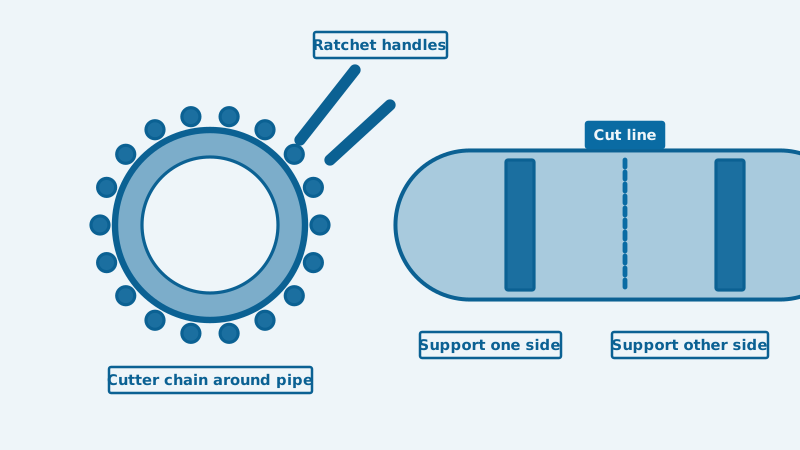
Cut cast iron drain pipe square with a snap cutter, a chain tool that squeezes the pipe until it breaks clean, or with a reciprocating saw and a metal-cutting blade. Support the pipe on both sides first, then rejoin the cut ends with a no-hub coupling. Cast iron carries your waste and also your vent system, which is why clogged drain vents and slow drains are often discussed together. This page is about the cut itself and the decisions around it.
What is the best way to cut cast iron drain pipe?
The best way is a snap cutter, which is how cast iron soil pipe is normally cut in the field. The chain wraps the pipe, the wheels press in, and the pipe snaps cleanly and square. A reciprocating saw with a metal blade or a grinder also works, but the cut is slower and rougher.
Tools, in the order most plumbers prefer:
- Snap cutter. Gives a square, fairly clean cut with no sparks. Chain sizes cover the usual 2, 3 and 4 inch pipe.
- Reciprocating saw with a metal blade. Good where a cutter will not fit, such as tight to a wall. Expect to go through several blades.
- Angle grinder with a cutoff wheel. Fast but throws sparks and iron dust. Use it away from flammable material.
Before you cut:
- Stop water use. No flushing, no showers, no laundry. A drain with water in it will pour wastewater from the cut.
- Support the pipe. Vertical stacks carry weight and can drop when cut. Use pipe hangers, straps or a prop above and below. Hubless pipe should be supported at each coupling.
- Mark a straight line. Use a wrap of tape or a marker. Square cuts seal better in a coupling.
- Wear protection. Eye protection, gloves, hearing protection and a dust mask.
- Have a bucket and rags ready. There is always some water left in the line.
After the cut, knock off sharp edges with a file and wipe the ends clean so the coupling gasket can seal. Cap or plug the open pipe with a test plug, since an open drain line lets sewer gas into the room.
How do you replace or join a section of cast iron drain pipe?
You replace a section by cutting out the bad piece, then joining a new piece with two no-hub couplings. Each coupling has a rubber sleeve and a stainless steel shield with clamps. The new piece can be cast iron or a plastic pipe such as ABS or PVC, joined with the correct shielded coupling for each.
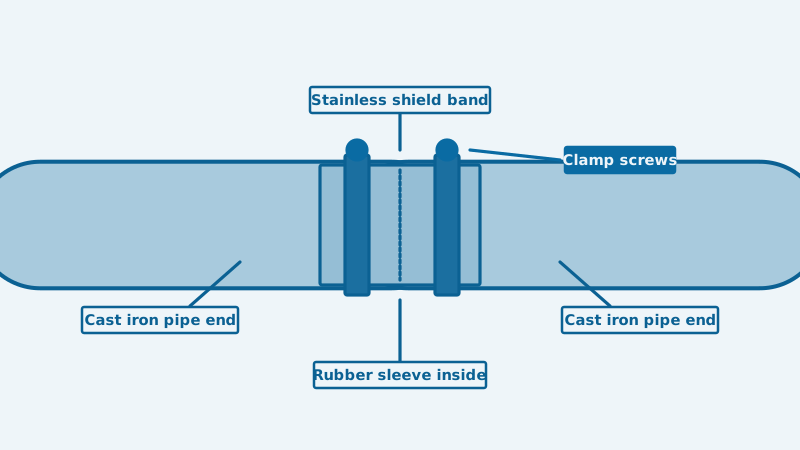
The steps:
- Cut out the damaged section, leaving clean, square ends on both sides.
- Cut the new piece to fit the gap, so the pipe ends meet inside each coupling the way the manufacturer's instructions show.
- Slide a coupling onto each end of the old pipe.
- Fit the new piece, slide the couplings so they cover each joint evenly, and tighten the clamps in the order the manufacturer gives, to the torque on the coupling.
- Support the pipe near each coupling.
- Test by running water and checking each joint.
Use couplings that meet a recognised standard. The plumbing code text and the Cast Iron Soil Pipe Institute refer to CISPI 310, ASTM C1277, ASTM C564 and ASTM C1563. The package should say which one applies. Do not use a plain rubber sleeve with hose clamps in place of a proper no-hub coupling.
Old hub-and-spigot joints, where one pipe end flares to take the next, are often sealed with lead and oakum, a rope-and-lead packing. Lead is a health hazard when it is cut, melted or ground, so do not cut or heat lead joints. If your pipe has them, leave the work to a plumber.
How do you fix a leaking cast iron drain pipe?
A pinhole or seam leak can be held temporarily with a repair clamp or epoxy putty, but a leak in cast iron is usually a sign of corrosion, and the surrounding pipe is likely thin too. The lasting fix is to cut out the leaking section and replace it, or to replace the run.
How to think about it:
- Pinhole or weeping joint. A rubber repair clamp or a patch sleeve can hold for a while. It is a stopgap.
- Cracked pipe or a split. Cut out and replace the section.
- Leaks at several places. The pipe has corroded. Plan a larger replacement.
- A wet stain on a ceiling below. This is often a leak in a stack or a joint above. Find it before the ceiling is damaged.
Cast iron corrodes from the inside as well as the outside. Rust builds up inside the pipe wall, which narrows it and roughens it. That is one reason older houses with cast iron can have slow drains and repeated clogs, since debris catches on the rough surface. See crack in cast iron drain pipe and how to fix a leaking cast iron drain pipe for more.
What size is cast iron drain pipe, and what fittings does it use?
Cast iron drain pipe is sold by nominal size, such as 2, 3 or 4 inch, and the actual outside diameter is larger than the number. Check the size by wrapping a tape around the pipe or reading the markings, and buy the coupling to match. Branch drains are commonly 2 or 3 inch and a main stack is often 3 or 4 inch.
What to keep in mind:
- Match the coupling to the pipe size. A 4 inch coupling goes on 4 inch pipe, not 3.
- Transitions need the right coupling. Joining cast iron to plastic uses a shielded coupling made for that transition.
- Fittings. Cast iron fittings include wyes, sanitary tees, bends and cleanouts. Pick fittings that keep waste flowing downhill, and ask a plumber if you are unsure which fitting a branch needs.
- Roof drain pipe. Cast iron is also used for roof drains and leaders in some buildings. These carry rain, and a blockage with leaves backs water up. They are a different system from your sewer drain.
How long does cast iron drain pipe last, and when should you hire help?
Cast iron drain pipe commonly lasts many decades, but old pipe corrodes, cracks and thins. If yours is the original pipe in an older Los Angeles home, expect rough inner walls and the occasional leak. Hire a plumber for stacks, buried runs, lead joints, anything near a gas line, and any job that needs a permit.
Signs the pipe is near the end of its life: rust stains or weeping at joints, flaking scale in the trap, drains slow throughout the house, and a clog that returns. A camera look inside the drain lines shows the condition. In the City of Los Angeles, plumbing work on drain pipes generally needs a permit, so check with the building department before you start. Cutting the wrong pipe can also leave a house with no working drain.
For a price on replacement, see cast iron drain pipe replacement cost. If the pipe in your house is past patching, a quote request starts a visit from a local plumber we'll arrange. Our other services are on the LA Drain Works home page.
Questions people ask
Can you cut cast iron pipe with a hacksaw?
You can, but it is very slow, and a standard hacksaw blade will wear out. A reciprocating saw with a metal-cutting blade is much faster. A snap cutter is faster still and leaves a cleaner edge. If you only have a hacksaw, use a new blade and cut slowly, resting the pipe.
How do you cap a cast iron drain pipe?
Use a rubber test cap with a stainless clamp for a hubless pipe, or a cast iron cap. A temporary cap keeps sewer gas out while you work. A permanent cap on a live drain is a plumber's job, since a capped line that should carry waste will back up.
Can I connect an ABS pipe to cast iron?
Yes, with a shielded no-hub coupling made for joining plastic to cast iron. The coupling bridges the difference in outside diameter, which is why a plain sleeve or glue will not do. Do not glue ABS to cast iron. Support the pipe on both sides of the joint, and test the joint with water before you close up the wall or ceiling.
Is old cast iron drain pipe worth keeping?
If it is not leaking and drains well, it can stay in service. Cast iron is quiet and strong. If it leaks, has rough scale or breaks when touched, replacing it is better than patching it. A camera look shows what the pipe looks like inside before you decide.
Sources used
Page updated