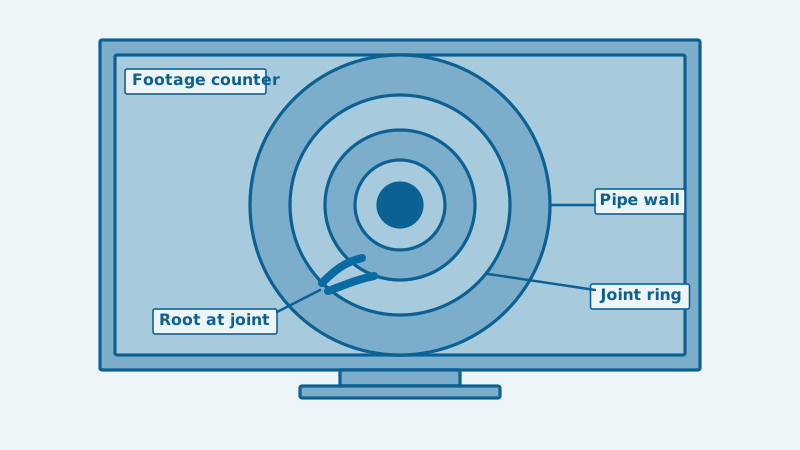
A sewer pipe inspection camera service sends a waterproof camera on a flexible rod or a small motorized crawler down your sewer line, and records what it finds. You should end up with footage with a distance counter, a plain account of each defect and where it sits, and a recommendation. Everything else on this page helps you judge whether the person you hire delivers that. The equipment itself is covered in our guide to the sewer camera with locator, and this page is about the service.
What does a sewer video inspection camera service include?
At minimum, the visit includes access to the line, a pass of the camera from the cleanout toward the street, a live look at the screen with someone who can explain it, and a recording. Better services add a locating pass to mark any defect on the ground, and a written summary of what they saw.
Ask whether these are included, because they are where prices differ:
- The recording. Footage you keep, with a running distance in feet, so a break at 43 feet can be found again.
- The locating. A marker on the ground over each defect, with a depth estimate, if one will be dug.
- The report. A list of defects with distances, a rating of how serious each is, and a repair suggestion.
- Cleaning. A badly blocked line often cannot be filmed until it is cleared, which may be a separate charge.
A camera does not repair anything. It tells you whether the problem is a clog or a defect, and that decides what you spend next.
What will the inspector actually find?
The camera finds roots, cracks, offset joints, sags where water pools, grease and scale, collapsed sections and sometimes a pipe that is not the material you thought it was. Each tells you something different. Roots at joints mean cleaning will keep recurring. A collapse means repair.
What these look like on screen:
| On the screen | What it usually means |
|---|---|
| Fine white or tan threads at a joint | Root hairs entering a joint |
| A thick brown mass filling the pipe | A root ball |
| A pool of standing water in the middle of the run | A sag, sometimes called a belly |
| A joint where one pipe edge sits lower than the next | An offset |
| A pipe that looks oval or flattened | A pipe that is collapsing, often Orangeburg |
| Soil or gravel visible through the pipe wall | A break or a missing section |
Older homes may have vitrified clay, cast iron or Orangeburg laterals, and the camera shows which. See old clay sewer pipe for what each one looks like when it ages.
What do I get as the report, and what should I ask for?
Ask for the video file, a written list of defects with the distance of each, and a statement of whether the line is passing, worth monitoring or needs repair. Some inspectors also code defects to a standard system with severity scores. That is helpful when a city or buyer wants the details, and you can ask the inspector how they code.
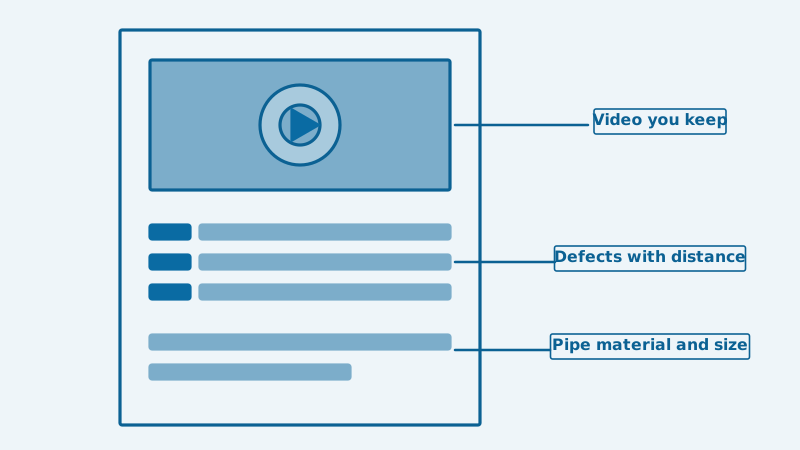
Keep the footage and the report. You may need them for three things: getting repair prices from other companies, applying for the city rebate, and discussing a sale. Los Angeles Sanitation's CCTV rebate, which pays up to $300 on its current terms, asks for the video with the address shown at the start and a written condition report, from a bonded sewer contractor, and the inspection can be no more than 6 months old when you apply, so confirm the rules before you book.
Reports vary a lot. A good one names what was seen, gives distances, and does not make claims the video does not support.
How do I choose a sewer camera service near me?
Choose one that explains what it will do before it arrives, gives you the footage, and tells you the price in writing. Ask whether the camera is a push rod or a crawler, how long a run it can handle, and whether the price includes locating and a report. A very cheap inspection that gives no recording is not worth much.
Questions to ask:
- What does the price include, and what costs extra?
- Do I get the full recording and a written report?
- Can you locate any defect on the surface?
- What happens if the line has to be cleaned first?
- Who will explain the screen to me while it runs?
If a defect is found in the lateral, remember that the owner is responsible for it, for the entire length of the lateral according to Los Angeles County Public Works, and the repair route depends on what the camera shows.
How much does a sewer pipe inspection camera service cost?
Published guides put a camera inspection of a sewer line at roughly $125 to $750 nationally, with the higher end for longer lines, locating and written reports. Local prices vary, so treat figures as a guide. Our page on camera drain inspection cost breaks down the drivers, and a written quote is the real price.
Two clues about price. A camera pass combined with a cleaning is often cheaper than two visits. And a camera done after a cleaning shows whether the problem was cleared or is still there.
If you are buying a home, a sewer scope inspection is the version timed to a sale. For a clog that keeps returning, an inspection is the first step before any cleaning bill. Our sewer camera inspection page describes what the line shows and when to book.
How do I book one?
Send a quote request with a line about what is happening, such as a repeat backup, a smell in the yard or a home purchase. We arrange a local drain cleaner to visit, and you get the price in writing before any work starts. Nothing is done until you agree. The rest of our services are on the LA Drain Works home page.
Questions people ask
How long does a sewer camera inspection take?
Most take 30 to 60 minutes for a standard house lateral, longer if the line is long, there is no easy cleanout or the line needs cleaning first. The inspector runs the camera to the main and back, and can stop to look at any defect. The time spent explaining the footage is usually part of that.
Do I need a cleanout for a camera inspection?
It helps a lot. A cleanout lets the camera enter the line directly. Without one, the inspector may pull a toilet to get access, which adds time and a little risk to the toilet's seal. If you do not have a cleanout, installing one is worth asking about, since it makes every later inspection and cleaning easier.
Can a camera see through roots or a blockage?
No. A camera stops at a blockage, and it cannot see past a mass of roots. If the line is blocked, the inspector clears it first, or films from the other end if there is access. This is why many inspections include a short cleaning, and why a quote should say what happens if the line is blocked.
Is a sewer camera inspection worth it?
It is worth doing when you have repeat backups, when roots are suspected, before you buy an older home and before you pay for a repair. It costs a fraction of most repairs and shows whether the repair is needed. For a house with no trouble and a modern pipe, it is less urgent.
What is the difference between a push camera and a crawler?
A push camera is a head on a flexible rod that the operator feeds into the pipe by hand. A crawler is a small motorized tractor that drives the camera down the pipe and is steered from a console. Push cameras suit house laterals. Crawlers suit larger and longer pipes.
Sources used
- LA Sanitation, Sewer Lateral CCTV Rebate
- Los Angeles County Public Works, Sewer: owner responsibility for the lateral
- Los Angeles County Public Works, CCTV inspection guidelines for acceptance of sewers (agency deliverables)
- Pipeline video inspection, camera types
- Published camera inspection prices from Los Angeles area plumbing businesses and national cost guides, checked November 2026
Page updated